

A poor credit report is a reason to assess an application carefully, not the whole story. To understand how to check tenant references in Victoria, consider relevant rental history, references provided by the applicant and their capacity to pay rent together. Put any report in context before making a decision, and base the assessment on evidence relevant to the property.
From 31 March 2026, rental providers and agents must use Victoria’s mandatory standard rental application form. This guide explains how tenant databases and rental-history checks fit into an assessment, what a property manager can do within the rules, and how to interpret adverse credit information without overlooking the rest of an applicant’s circumstances. You’ll come away with a clearer picture of the checks involved and when professional tenant selection and vetting can help.
Key Takeaways
- Assess an adverse credit report alongside relevant rental history and the applicant’s ability to pay, rather than treating one result as the whole picture.
- Understand what notice applicants must receive when a tenant database search finds a listing, and what information that notice needs to include.
- See how applicant-provided references can help clarify rental history while keeping checks within Victoria’s rules.
- Learn how a property manager can bring application information together to support a consistent, considered tenant assessment.
Tenant databases used to assess rental applications
Victorian landlords may assess identity, ability to pay the advertised rent, rental history and references. From 31 March 2026, applications must use the standard form, and rental application fees are prohibited.
Permitted applicant information
Permitted information is information relevant to assessing an applicant against the advertised rental and their references. Section 30BA of the Residential Tenancies Act 1997 concerns prescribed information, while section 30AC concerns the application form. A rental provider or agent may request details for up to two personal referees. They can contact an employer only if the applicant chooses to include that employer as a reference. This keeps screening focused on tenancy suitability and helps reduce discriminatory decisions based on personal characteristics unrelated to renting.
Applicant identity verification
Identity verification confirms who is applying for the rental agreement. In Victoria, a rental provider or agent may request no more than two identity documents from the listed options. They may also request no more than two documents to assess the applicant’s capacity to pay rent. These limits help keep an application proportionate. Requesting extra identity evidence or information outside the prescribed form can breach the rules.
Use and protection of applicant information
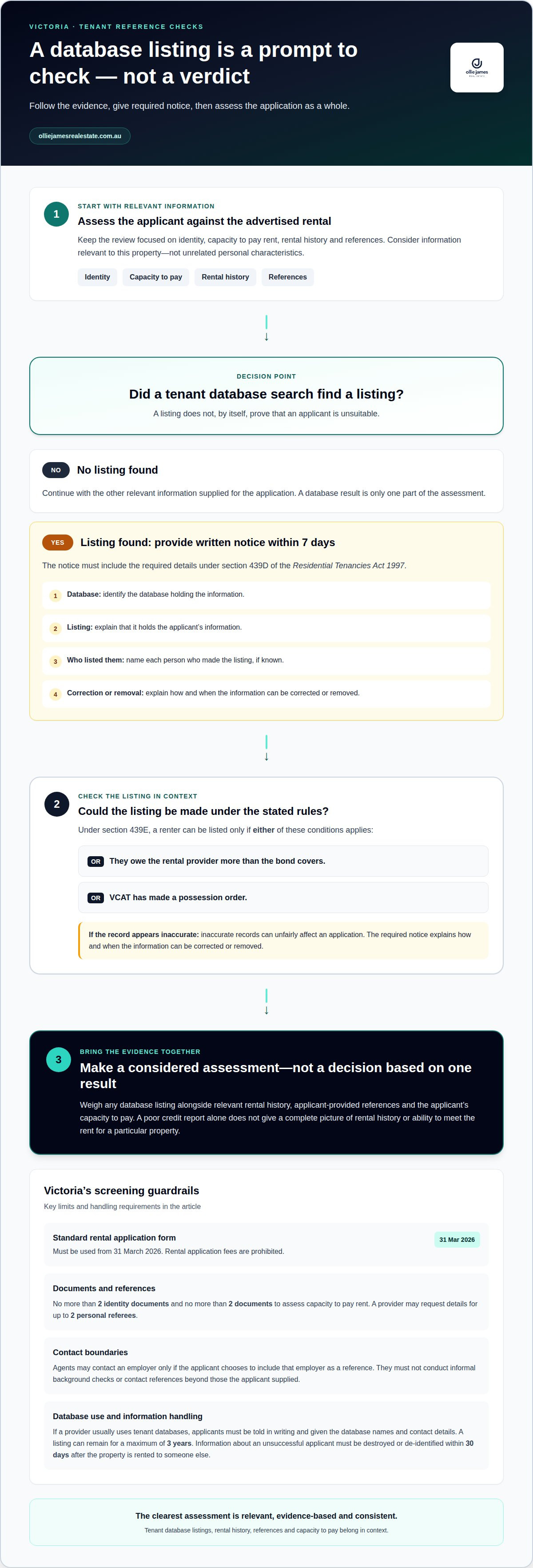
Applicant information must be used only to assess suitability for the property or another legitimate reason. A provider who usually uses tenant databases must tell applicants in writing and provide the database names and contact details, under section 439C. If a search finds a listing, written notice is required within 7 days under section 439D. It must identify the database, explain that it holds the applicant’s information, name each person who made the listing if known, and explain how and when it can be corrected or removed. A listing can remain for a maximum of 3 years. Information about an unsuccessful applicant must be destroyed or de-identified within 30 days after the property is rented to someone else. Inaccurate records can unfairly affect an application, while discriminatory decisions may breach the Equal Opportunity Act 2010.
Checking rental history and contacting previous property managers
Assess rental history using references supplied by the applicant and relevant tenancy information. A clear process for how to check tenant references in Victoria helps keep enquiries focused and fair.
Rental history and previous contacts
Rental history checks use information about previous tenancies and references supplied by the renter. From 31 March 2026, applicants may provide addresses for 2 previous rental properties, if available, and landlord or agent contact details. Agents may contact a current or previous rental provider, or up to two additional references provided by the applicant. This gives professionals a relevant basis for assessing tenancy conduct.
Tenant blacklist and rental history screening
A tenant database listing is not a general blacklist or proof that an applicant is unsuitable. Under section 439E of the Residential Tenancies Act 1997, a renter can be listed only if they owe the rental provider more than the bond covers, or VCAT has made a possession order. A professional assessing how to check tenant references in Victoria should weigh any listing against other relevant application information, rather than treating it as a complete rental history.
Bond history and previous disputes
Bond outcomes and disputes with previous landlords do not necessarily show how someone will meet a new rental agreement. In Victoria, agents cannot ask applicants about their bond history or whether they had a dispute with a previous rental provider. They must not conduct informal background checks or contact references beyond those the applicant supplied. This keeps enquiries within permitted boundaries.
Information rental providers can request
Section 30BA of the Residential Tenancies Act 1997 concerns prescribed information rental providers may request. Applicants may be asked for the names and contact details of up to 2 referees who can explain why they would be suitable tenants. From 31 March 2026, agents may contact an employer only if the applicant chooses to include them as a reference.
Using property managers for tenant screening
A property manager can apply a consistent screening process, from reviewing the application to weighing references and relevant records. Private landlords and real estate agents must follow Victoria’s rental-provider requirements. Appointing an agent does not remove those obligations.
For a prospective renter, the agent organises information around the advertised property, then assesses identity, capacity to pay, rental history and references. A structured review helps distinguish a missing document from a concern about suitability. It also keeps decisions focused on the application rather than assumptions about the applicant’s personal circumstances.
From 31 March 2026, agents must use Victoria’s standard rental application form. They cannot add follow-up questionnaires, request extra documents outside that form, or ask additional screening questions by phone or email. An agent may contact an employer only if the applicant chooses to include them as a reference. These boundaries give property managers a defined process for gathering and using personal information.
Tenant database records can inform an assessment, but any listing needs context. Consider what the record says alongside the rental references supplied and other relevant application information. A poor credit report alone does not give a complete picture of someone’s rental history or ability to meet the rent for a particular property. The key question is whether the available, permitted information supports a fair assessment.
For landlords who want professional support applying these requirements, explore property management support for tenant screening.
Private landlords and real estate agents must follow Victoria’s rental-provider requirements. Agents must use the standard rental application form and observe limits on follow-up questions and document requests. They may contact an employer only if the applicant includes them as a reference.
Ollie James Real Estate: Tenant Selection and Vetting
Ollie James Real Estate provides Tenant Selection and Vetting for landlords seeking support to assess rental applications and references. A property manager can bring the application information together, consider relevant rental history and database results, and help keep the screening process aligned with Victoria’s requirements.
This support can help when you’re managing a rental property alongside other commitments or when an application calls for careful, consistent assessment. The focus is on considering the full application, rather than treating one reference or credit result as the whole picture.
If you’d like support with tenant selection for your property, contact Ollie James Real Estate.
Make your next property decision with confidence
Knowing how to check tenant references in Victoria is one part of managing a rental investment. Consider how much time and attention you can give the tenancy, and whether professional support would help you make a clear, considered decision. A consistent process can make a high-pressure choice easier to manage.
Ollie James Real Estate offers Tenant Selection and Vetting for landlords seeking support with applicant assessment. The agency also provides Residential Property Sales, Property Management and Land Sales to support different property goals.
If you’re ready to discuss tenant selection for your rental, contact Ollie James Real Estate. A thoughtful next step can help you move forward with greater clarity.
Frequently Asked Questions
Can I reject a tenant based on a bad credit report?
Not automatically. A poor report may be relevant to an applicant’s capacity to pay rent, but assess it alongside accurate, current information and the rest of the application. For example, do not treat an entry that has since been corrected as a current unpaid debt. Base decisions on relevant tenancy factors, not protected personal characteristics.
What are tenant databases?
Tenant databases contain tenancy-related records used by rental providers and agents as screening tools. They are not a complete rental history or a general measure of someone’s character. A listing must meet Victoria’s legal criteria, and applicants can request access to information held about them. Treat a database result as one piece of evidence, not the whole application.
What questions can a property manager ask a tenant’s previous property manager in Victoria?
A property manager can ask an applicant-provided rental reference about relevant tenancy matters, such as rent payment and care of the property. From 31 March 2026, agents cannot add screening questions by phone or email. Keep enquiries within the supplied reference and information relevant to assessing the rental application.
How can a property manager contact an applicant’s current landlord in Victoria?
A property manager may contact a current landlord or rental agent if the applicant provides them as a reference. Use the contact details supplied for that reference and keep enquiries relevant to the tenancy. An agent cannot independently contact an employer unless the applicant includes them as a reference.
Can Victorian landlords check rental databases, and what consent and notice rules apply?
Yes. Before background checks, including database searches, credit checks and landlord reference calls, landlords must obtain written consent. If they usually use a tenant database, they must also tell applicants in writing and provide its name and contact details. If a search finds a listing, written notice must follow within 7 days, explaining how it can be corrected or removed.


