

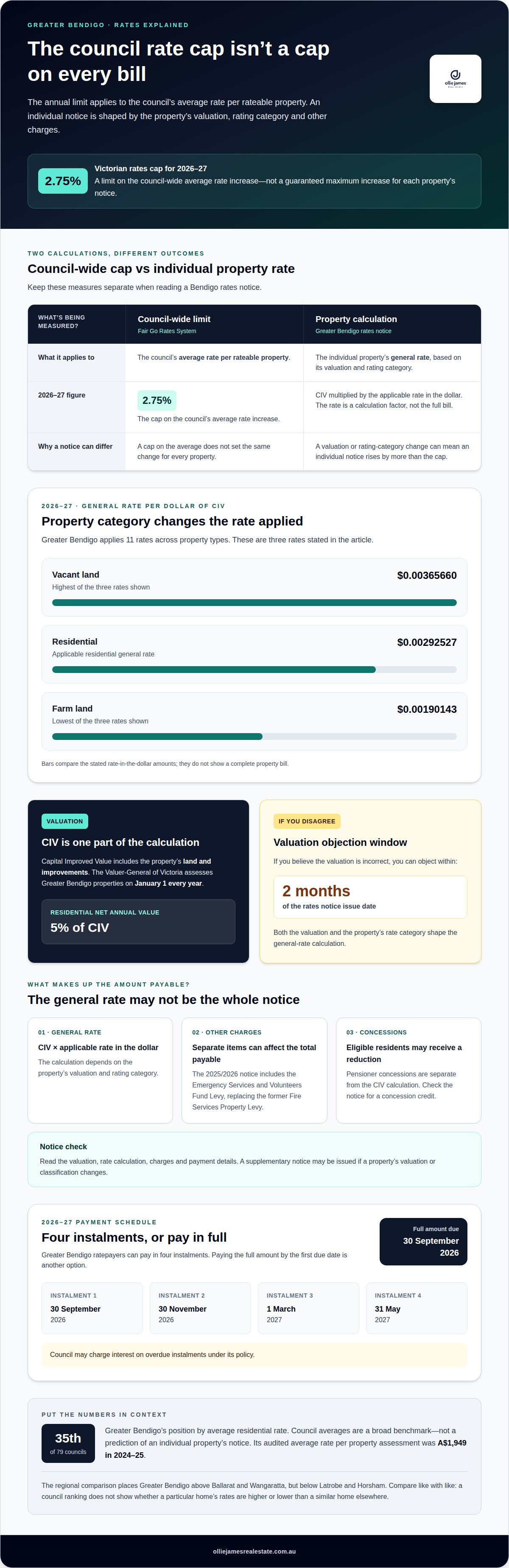
The Victorian rates cap for 2026-27 is 2.75%, but an individual Bendigo rates notice can rise by more. The cap applies to the council’s average rate per rateable property, while a property’s valuation and rating category affect its own bill. Getting Bendigo council rates explained clearly starts with separating those two calculations.
It’s understandable to expect a cap to limit the increase on every bill, especially when household costs are already under pressure. This guide explains how Capital Improved Value shapes Bendigo council rates, what the annual cap does and doesn’t limit, and how Greater Bendigo compares with regional councils. You’ll also see why a higher valuation doesn’t automatically mean every property’s rates rise by the same amount, helping you understand your notice and plan for property costs.
Key Takeaways
- Greater Bendigo calculates rates using Capital Improved Value and the rate that applies to the property type; valuation objections can be made within two months of the notice issue date.
- A rates notice can include charges beyond the general rate, so understanding each line helps explain the total property cost.
Capital improved value and individual rates notices
Greater Bendigo calculates rates using a property’s Capital Improved Value (CIV) and the applicable rate in the dollar. The valuation is one part of the notice; other charges can affect the total payable.
Understanding Capital Improved Value
CIV is the assessed value of a property, including its land and improvements. The Valuer-General of Victoria assesses Greater Bendigo properties on January 1 every year, and council multiplies the CIV by the relevant rate in the dollar. For residential properties, Net Annual Value is 5 percent of CIV. If you believe the valuation is incorrect, you can object within two months of the rates notice’s issue date. The valuation and the rate category both shape the calculation.
Rates Notice Types and Details
A supplementary rates notice is issued when a property’s valuation or classification changes, so a changed assessment can affect what you owe during the year. An electronic rates notice is the digital version of a council notice. Whether received digitally or otherwise, read the notice for the property valuation, rate calculation, charges and payment details. For 2025/2026, Greater Bendigo’s notice includes the Emergency Services and Volunteers Fund Levy, which replaced the former Fire Services Property Levy.
Pensioner concessions are separate from the CIV calculation and may reduce rates for eligible residents. Check the notice for a concession credit. Eligibility and the amount depend on the applicable concession rules and the property’s circumstances.
If paying on time is difficult, contact Greater Bendigo’s Customer Support Officers on 1300 002 642 to discuss payment arrangements. Weekly, fortnightly or monthly payments may be arranged, helping spread payments rather than leaving the full balance until an instalment is due.
How much can Victorian council rates rise each year?
Victoria’s Fair Go Rates System caps how much councils can raise general rates. For 2026-27, the cap is 2.75% of a council’s average rate per rateable property. If you need Bendigo council rates explained, distinguish this council-wide limit from the amount on an individual notice.
Greater Bendigo calculates a property’s general rate by multiplying its Capital Improved Value by the applicable rate in the dollar. For 2026-27, the general rate is $0.00292527 per dollar of Capital Improved Value. The rate is a calculation factor, not the full bill, which may include other charges.
Property category also matters. Greater Bendigo applies 11 rates across property types. For 2026-27, the vacant land rate is $0.00365660 per dollar, while the farm land rate is $0.00190143 per dollar. A property’s category and valuation therefore both affect its general-rate calculation.
The clearest way to understand Bendigo council rates is to distinguish the annual cap from an individual property’s assessment. A notice can rise by more than the cap when the valuation or rating category changes. Greater Bendigo has not applied for a rate-cap variance since the system began.
Greater Bendigo ratepayers can pay in four instalments. For 2026-27, the due dates are September 30, 2026, November 30, 2026, March 1, 2027 and May 31, 2027. Paying the full amount by September 30, 2026 is another option. Council may charge interest on overdue instalments under its policy.
For a property purchase, include council rates among the ongoing costs you consider. An investment property pre-purchase assessment can help place those costs in the context of your plans.
Rates compared with other regional Victorian councils
Greater Bendigo ranks 35th of 79 Victorian councils by average residential rate. These figures provide a broad benchmark, not a prediction of an individual household’s notice. A property’s valuation and rating category still shape its actual rates.
The comparisons place Greater Bendigo above Ballarat and Wangaratta, but below Latrobe and Horsham. Each figure describes a council-wide average, not the amount every resident pays.
Use these figures to put regional councils in context, not to predict a specific property’s bill. A council’s ranking also doesn’t show whether a particular home’s rates are higher or lower than those of a similar home elsewhere. Compare like with like, and treat council averages as a guide, not an individual assessment.
Check the period and measure before comparing figures across years. Greater Bendigo’s audited average rate per property assessment was A$1,949 in 2024-25. A rates notice can also include separate charges: Greater Bendigo’s 2025/2026 notice includes the Emergency Services and Volunteers Fund Levy.
Ollie James Real Estate
Ollie James Real Estate helps people make informed property decisions when ongoing ownership costs, including council rates, are part of the picture. If you’re considering buying or selling a home, purchasing land or arranging property management, local guidance can help you weigh broader costs against your plans. For investors, tenant selection and vetting can support residential property management. These services help with property decisions; the council sets rates and issues the notice.
If you’re weighing up a property move or management decision in Bendigo, contact Ollie James Real Estate to discuss your situation.
Make your next property decision with clarity
With Bendigo council rates explained, you can bring property costs into a more informed conversation about buying, selling or managing a home. Rates are one part of ownership; the right next step depends on your plans for the property and the decisions ahead.
Ollie James Real Estate supports residential property sales, property management and land sales across local property journeys. If you’re considering a move or reviewing how a property fits your plans, experienced regional guidance can help you approach that decision with greater confidence.
Contact Ollie James Real Estate to discuss your property plans. Take the next step when you’re ready.
Frequently Asked Questions
What is the Fire Services Levy?
The Fire Services Property Levy was the former levy used to fund fire services. For the 2025/2026 rates notice, Greater Bendigo includes the Emergency Services and Volunteers Fund Levy instead. The former levy began in 2013 following a recommendation of the Bushfire Royal Commission. If you’re reviewing an older notice, check its year and levy name before comparing charges.
What is the average council rate in Greater Bendigo City Council?
This is a council-wide average for residential properties, not a set amount charged to every household. An individual notice can differ because property valuations and rate categories vary. The figure refers to the average residential rate, so it shouldn’t be treated as the total of every charge on a notice.
How are City of Greater Bendigo council rates calculated?
Greater Bendigo calculates a property’s rate by applying the relevant rate in the dollar to its Capital Improved Value. The applicable rate depends on the property category, and the notice may include charges beyond the general rate. For example, vacant land and residential properties don’t necessarily use the same rate. That’s why two properties with similar values can receive different rate assessments.
What is the current City of Greater Bendigo rate in the dollar and how is property value assessed?
For 2026-27, Greater Bendigo’s general rate is $0.00292527 per dollar of Capital Improved Value. The Valuer-General of Victoria assesses property valuations on January 1 every year. The rate in the dollar is a calculation factor, not the full bill: the property’s valuation and category determine the general-rate amount. Separate charges may also appear on the notice.
What rates and charges appear on a Bendigo rates notice, including waste and municipal charges?
A Bendigo notice can show the general rate, applicable waste charges and the Emergency Services and Volunteers Fund Levy. Greater Bendigo’s 2025/2026 notice includes that levy in place of the former Fire Services Property Levy. Review the itemised breakdown for any municipal charge shown, as well as payment details. The final total depends on the property’s applicable rates and charges.


