

The best investment property isn’t automatically a house or an apartment. What makes a good investment property is whether local renters are likely to want it, its ongoing costs fit your budget, and its expected rent supports the cash flow you need. In Australia, the right choice depends on the suburb, the property’s condition and your investment priorities, not just the purchase price.
There’s a lot to weigh before making a significant financial decision, so a clear way to compare options helps. This guide explains how to assess rental demand, account for ongoing costs and estimate cash flow before choosing what to buy. These checks can help you judge whether a property suits your budget and investment goals.
Key Takeaways
- Assess rental demand by considering local amenities, tenant appeal and rents for similar properties in the area.
- Compare property types with their full ownership costs in mind, including maintenance, strata fees where relevant and periods without a tenant.
- Estimate cash flow by weighing expected rent against loan repayments and ongoing expenses, then test how changes in interest rates could affect your budget.
- Use an investment property pre-purchase assessment to help weigh a property’s likely demand, costs and cash flow before deciding whether it suits your goals.
1. Infrastructure, population growth and rental demand
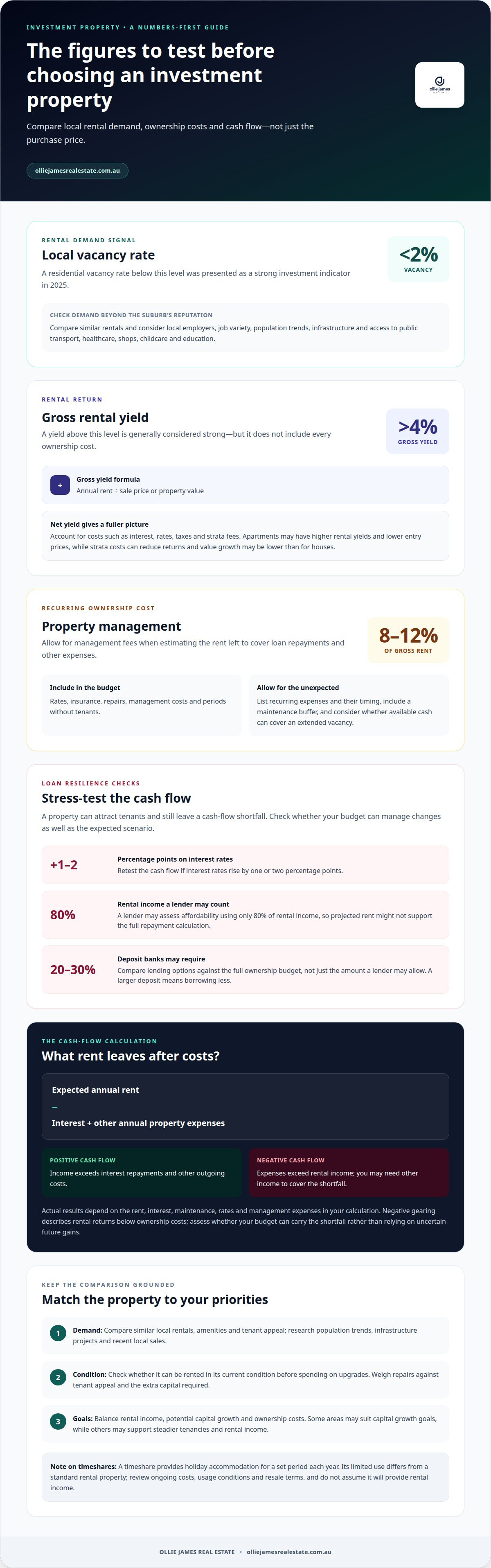
To assess what makes a good investment property, start with rental demand and local vacancies. In 2025, a residential vacancy rate below 2% was presented as a strong investment indicator. Consider nearby employers and the range of local jobs, as employment opportunities can shape the pool of prospective tenants. Compare similar rentals to judge demand rather than relying on a suburb’s reputation alone.
Research population trends, infrastructure projects and recent local property sales before choosing a suburb. Check access to public transport, healthcare, shops, childcare and education, since these amenities may influence tenant interest and achievable rent. Compare sales and rents for similar properties to understand local conditions. Some areas may suit capital growth goals, while others may support steadier tenancies and rental income.
Calculate gross rental yield by dividing annual rent by the property’s sale price or value. A yield above 4% is generally considered strong, but it doesn’t capture every ownership cost. Net yield accounts for expenses such as interest, rates, taxes and strata fees. Apartments may offer higher rental yields and lower entry prices, but strata costs can reduce returns, and value growth may be lower than for houses.
If you’re considering what makes a good investment property, balance rental income against potential capital growth and ownership costs. Renovations may improve rental appeal, but first assess whether the property can be rented in its current condition. ANZ advises investors to do this before spending on upgrades. Weigh repairs against their likely effect on tenant appeal and the extra capital required, keeping expected income and long-term goals in view.
2. Ongoing ownership costs, vacancies and loan repayments
Buying with a mortgage means budgeting for more than repayments. Include rates, insurance, repairs, management costs and periods without tenants. A vacancy can interrupt rental income while loan repayments and property expenses continue. Model an extended vacancy and check whether your available cash can cover the gap.
Compare expected long-term returns, including rental income and potential capital gain, with borrowing costs. ANZ advises choosing a location within budget so upfront costs and future repayments remain manageable. Also test the cash flow if interest rates rise by one or two percentage points. If a lender assesses affordability, it may count only 80% of rental income, so projected rent might not support the full repayment calculation.
For a realistic estimate, list each recurring expense and its timing. Allow for maintenance and management fees, then include a buffer for unexpected repairs. Management can cost around 8% to 12% of gross rental income. Check how that expense changes the rental yield and the amount left for mortgage repayments. A property’s cash flow is positive when income exceeds interest repayments and other outgoing costs; otherwise, you may need to fund the shortfall.
A timeshare gives the holder use of holiday accommodation for a set period each year. That limited use differs from a standard rental property, so review the agreement’s ongoing costs, usage conditions and resale terms before buying. Don’t assume it will provide rental income or function like a property investment. Negative gearing describes rental returns below ownership costs, so assess whether your budget can carry the shortfall without relying on future gains.
3. Calculating investment-property cash flow
Start with expected annual rent, then subtract interest and other annual property expenses. Positive cash flow means income exceeds interest repayments and outgoing costs; negative cash flow means expenses are higher. This calculation shows whether rent can support ownership or whether you’ll need other income to cover a shortfall.
Actual results depend on the rent, interest, maintenance, rates and management expenses used in your calculation.
Next, test how the loan affects your figures. A larger deposit means borrowing less, while interest rate changes affect loan repayments and cash flow. Banks may require a deposit of 20% to 30% when buying an investment property. Compare lending options with the full ownership budget, not just the amount a lender may allow. A home loan structure can also affect how interest and repayments shape your returns.
Negative gearing occurs when ownership costs exceed rental income. Tax treatment can affect the final result, but a tax offset shouldn’t replace a sound cash-flow calculation. ANZ recommends discussing the proposed investment with a registered tax agent, whatever your gearing strategy. A property may attract tenants and still have negative cash flow, while uncertain capital growth won’t cover repayments today.
For a property-specific view of expected rent and costs, arrange an investment property pre-purchase assessment before deciding whether the real estate fits your budget.
Ollie James Real Estate: Investment property pre purchase assessment
Ollie James Real Estate offers an investment property pre-purchase assessment to help you weigh a property’s rental appeal, ongoing costs and potential cash flow before deciding whether to buy. It’s a useful step when you’ve found a property but want to understand how its features and local rental demand align with your budget and investment goals.
Bring your questions about the property, expected rent and ownership costs. The assessment can help you consider the numbers alongside the property’s condition and potential tenant appeal, supporting a more informed decision. If you’re still comparing options, it can also help clarify which property type and investment priorities suit you.
Contact Ollie James Real Estate to discuss an investment property pre-purchase assessment.
Make your next property decision with confidence
Deciding what makes a good investment property also means considering how ownership fits your longer-term plans. Your priorities may change, so choose an approach that leaves room to reassess rather than relying on a single outcome. A clear conversation about your goals can help you decide what to pursue next.
Ollie James Real Estate supports property decisions through Residential Property Sales, Property Management and Land Sales. If you’re weighing up a particular investment or planning your next step, its local guidance can help you move forward with greater clarity.
Talk with Ollie James Real Estate about your property plans, and take the next step at a pace that feels right for you.
Frequently Asked Questions
What type of property?
The right property type is the one that matches your budget, likely tenants and investment plans. A unit may suit someone seeking a smaller property to maintain, while a house may appeal to local renters who value outdoor space or room for a household. Consider how easy the property may be to manage and sell later, not only its expected rent.
How long does it take to make a profit on an income property?
There’s no fixed timeframe for returns: rental income and ownership costs arise over time, while capital growth is realised only when you sell. Consider regular cash flow separately from any eventual sale proceeds when reviewing performance. A property might have a cash shortfall during ownership but still gain value, or earn rent without making a profit after all costs.
What are some of the pros and cons of an investment property?
An investment property can provide rental income and potential capital growth while giving you direct ownership of a tangible asset. It also concentrates your investment in one property and requires ongoing decisions about tenants, repairs and periods without rent. Before buying, consider whether you can manage those responsibilities alongside your other financial commitments and investment goals.
Where should you buy?
Choose a location that fits your investment aims and whose local conditions you can assess. In Central Victoria, compare properties and rental demand across Bendigo, Kangaroo Flat, Junortoun, Epsom, Eaglehawk, Strathfieldsaye, Strathdale, Kennington, Golden Square, California Gully, Maiden Gully and Marong. Review comparable sales and rentals in each area rather than assuming nearby suburbs perform alike.
What factors make a residential investment property attractive in Australia?
Practical features that suit everyday living, such as an internal laundry, air conditioning, parking or storage, may appeal to tenants. Apartments may also attract renters with a balcony or second bathroom. Weigh these features against the property’s condition and the needs of likely tenants: popular inclusions are useful only when they fit the local rental market.


