

What if a fair, consistent process could make choosing a tenant feel less uncertain? When applications contain different details and supporting documents, it can be hard to know what’s relevant, what you can ask for and how to compare applicants respectfully. A clear tenant screening checklist Victoria landlords can apply to every application helps keep the decision focused on evidence, not instinct.
This guide sets out practical steps for assessing information relevant to an applicant’s identity, ability to pay rent, rental history and references. You’ll also learn how to use consistent criteria, handle personal information carefully and check current Victorian requirements with Consumer Affairs Victoria. From reviewing applications to recording your decision, the checklist can help you take a measured approach and choose a suitable tenant with greater confidence. For landlords in Bendigo and Central Victoria, a structured process can bring clarity to a high-pressure decision.
Key Takeaways
- Use a tenant screening checklist Victoria landlords can apply consistently, focusing on relevant evidence rather than looking for a “perfect” applicant.
- Review identity, rental history, affordability evidence and references using the same criteria for every application.
- Compare evidence fairly, then record clear reasons for your decision without relying on arbitrary income thresholds or pass marks.
- Clear communication and organised application records can help you prepare for the next tenancy steps. Professional support can bring structure when the process feels complex.
What belongs on a tenant screening checklist in Victoria?
A sound screening process isn’t a hunt for a flawless applicant. It’s a consistent review of relevant evidence to help you decide whether an applicant is suitable for the tenancy. A tenant screening process may involve checking application details, rental history and references. For Victorian landlords, organise those checks around the same clear criteria for every applicant.
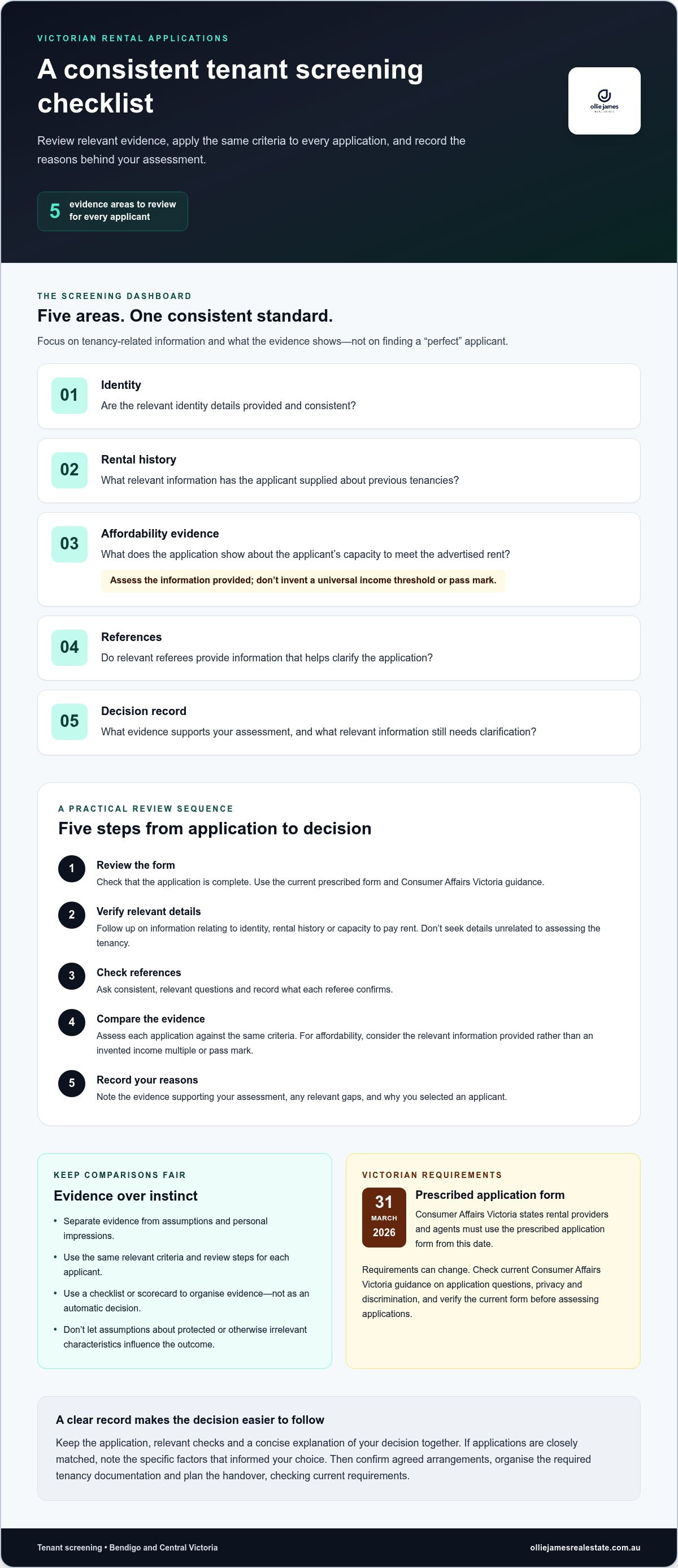
A practical tenant screening checklist Victoria landlords can use should cover five areas:
- Identity: Are the relevant identity details provided and consistent?
- Rental history: What relevant information has the applicant supplied about previous tenancies?
- Affordability evidence: What does the application show about their capacity to meet the advertised rent? Avoid inventing a universal income threshold or pass mark.
- References: Do relevant referees provide information that helps clarify the application?
- Decision record: What evidence supports your assessment, and what information still needs clarification?
What should a Victorian landlord assess in every application?
Use the same criteria and review steps for each applicant. Separate evidence from assumptions: a personal impression or information unrelated to the tenancy shouldn’t outweigh relevant application details. For a straightforward comparison, note what you reviewed, what it showed and whether any relevant detail needs clarification. Consistent comparisons make it easier to explain how you reached a decision and help keep the process respectful.
Victorian application requirements can change, so use Consumer Affairs Victoria guidance to check what information may be requested and how it should be handled. Consumer Affairs Victoria states that rental providers and agents must use the prescribed application form from 31 March 2026. Verify the current form and requirements before assessing applications, and keep your checklist aligned with that guidance.
How to use a tenant screening checklist fairly and consistently
A careful assessment doesn’t need to become complicated. A written tenant screening checklist Victoria landlords use for every application keeps the process practical: check relevant evidence, ask appropriate questions and apply the same criteria to each person.
- Review the form. Check that the application is complete and use the current prescribed form and Consumer Affairs Victoria guidance.
- Verify relevant details. Follow up on information that relates to identity, rental history or capacity to pay rent. Don’t seek details unrelated to assessing the tenancy.
- Check references. Ask consistent, relevant questions and record what each referee confirms.
- Compare the evidence. Consider each application against the same criteria. For affordability, assess the relevant information provided rather than applying an invented income multiple or pass mark.
- Record your reasons. Note the evidence supporting your assessment, any relevant gaps and why you selected an applicant.
How can landlords compare applicants without relying on gut feel?
Use a simple written checklist or scorecard, but assess the evidence rather than treating a score as an automatic decision. For example, if an application leaves a question about rental history, record the gap and seek relevant clarification consistently. Don’t let personal impressions or assumptions about protected or otherwise irrelevant characteristics influence the outcome. Check current Consumer Affairs Victoria guidance on application questions, privacy and discrimination so your process remains appropriate.
Consistent criteria make a diligent review manageable, even when several applications arrive at once. For landlords who’d value a structured approach to tenant selection and property management in Bendigo or Central Victoria, explore Ollie James Real Estate.
From screening decision to a well-managed tenancy in Bendigo
Once you’ve chosen an applicant, close the loop with clear, respectful communication. Keep the application, relevant checks and a concise record of why the evidence supported your decision together. If applications were closely matched, note the specific factors that informed your choice rather than relying on a general impression. An organised record makes the decision easier to follow later.
Then prepare for the tenancy’s next steps: confirm the agreed arrangements, organise the required tenancy documentation and plan the handover. Check current Consumer Affairs Victoria guidance for the requirements that apply. The tenant screening checklist Victoria landlords use is most valuable when it supports a clear process from application review through to the start of the tenancy.
For further local context, read Rental Property Management in Bendigo: A 2026 Guide for Tenants and Landlords.
When can professional property management make screening easier?
Support can be useful when several applications arrive at once, you’re short on time or you’re unsure how to assess each one consistently. A property manager can coordinate application reviews and relevant checks, compare evidence against shared criteria, and document the reasons for the decision. That structure can make a demanding choice feel more manageable.
Ollie James Real Estate provides property management and tenant selection and vetting across Bendigo and Central Victoria. If you’d value local support through screening and the next tenancy steps, you can explore property management support.
Make your next tenant decision with confidence
A fair tenant screening checklist Victoria landlords can reuse brings structure to a demanding decision. Assess each application against the same relevant criteria, keep assumptions out of the process and record the evidence behind your choice. Keep up to date with Consumer Affairs Victoria guidance so your application and information-handling practices reflect current requirements.
Once you’ve selected an applicant, clear communication and organised records help you move towards the next tenancy steps with confidence. If you’re managing multiple applications or want support with consistent tenant selection, local property management can make the process more straightforward.
Ollie James Real Estate is an independent, family-owned agency providing property management across Bendigo and Central Victoria, backed by over 17 years of local industry experience. Explore property management support to get help with your next tenancy.
Frequently Asked Questions
What should a tenant screening checklist include in Victoria?
A tenant screening checklist Victoria landlords use should cover the prescribed application form, relevant identity and financial details, rental history and references. Apply the same assessment criteria to each application, then keep a written record of the evidence behind your decision. Only request and use information appropriate to assessing the tenancy. Check Consumer Affairs Victoria’s current rental application and privacy guidance before setting or changing your process.
Can a landlord in Victoria reject a rental application?
Yes, a Victorian rental provider can select an applicant, but the decision must follow current rental rules and be made fairly. Compare applications using the same relevant criteria, and record the evidence supporting your decision rather than relying on assumptions or personal impressions. As rules can depend on the circumstances, check Consumer Affairs Victoria guidance before treating a particular reason for rejection as lawful.
Do Victorian rental providers have to use a prescribed application form in 2026?
Yes. Consumer Affairs Victoria guidance states that rental providers and agents must use the prescribed rental application form from 31 March 2026. Use the current form available through Consumer Affairs Victoria and consult its live guidance for requirements and the information requested. This applies to landlords across Bendigo, including Kangaroo Flat, Junortoun, Epsom, Eaglehawk, Strathfieldsaye, Strathdale, Kennington, Golden Square, California Gully, Maiden Gully and Marong.


