

Could a notice that gives one Victorian renter 90 days be wrong for another? The notice to vacate period Victoria requires depends on the reason, who is giving notice and the rules that apply. A familiar number alone won’t tell you whether a deadline is correct.
It’s understandable to feel unsettled when a notice arrives or you’re preparing to end a tenancy. This guide explains how renter notices differ from rental provider notices, what changed under reforms that took effect on 25 November 2025, and how to check the reason, form and dates before acting.
You’ll also find practical steps for keeping records, responding before a deadline and seeking help from Consumer Affairs Victoria or VCAT if something doesn’t seem right. A clear check can help you decide what to do next.
Key Takeaways
- The notice to vacate period Victoria requires depends on who gives notice and the reason stated, so identify both before assessing the deadline.
- Check your rental agreement type and compare the notice period with current Victorian requirements rather than relying on an old example.
- Review the notice’s form, stated grounds and key dates, and keep it with your rental agreement and related messages.
- If the notice or timing seems wrong, use current Consumer Affairs Victoria and VCAT guidance to understand your options and next steps.
Notice to vacate period in Victoria: who gives notice and why it matters
A notice to vacate is a formal notice from a rental provider telling a renter to leave a rented home by a specified date, for a reason allowed under Victorian rules. It’s different from a renter’s notice of intention to vacate, which tells the rental provider the renter plans to leave. Identifying which notice you have is the first step in working out the notice to vacate period Victoria requires for that situation.
The period isn’t one-size-fits-all. The reason for the notice, who gives it, the rental agreement and the current rules can all matter. A general explanation of the contractual idea behind a lease agreement can provide context, but Victorian rental requirements should be checked against Consumer Affairs Victoria’s current guidance.
This video discusses a rental provider moving back into a property. Treat it as an example, and check current Victorian requirements for your circumstances.
Is a renter’s notice the same as a rental provider’s notice?
No. A renter gives a notice of intention to vacate to end their tenancy, while a rental provider issues a notice to vacate on a legally permitted ground. The required time can differ: renters generally need to give 28 days’ notice, while the period for a provider depends on the reason and applicable rules.
Since 25 November 2025, a rental provider must have a valid reason to issue a notice, including at the end of a fixed-term agreement. Receiving a notice doesn’t mean a renter must leave immediately. Check the stated reason, vacate date and any required steps. If you dispute the notice, seek current Consumer Affairs Victoria or VCAT guidance.
Calculating Notice to Vacate Periods in Victoria
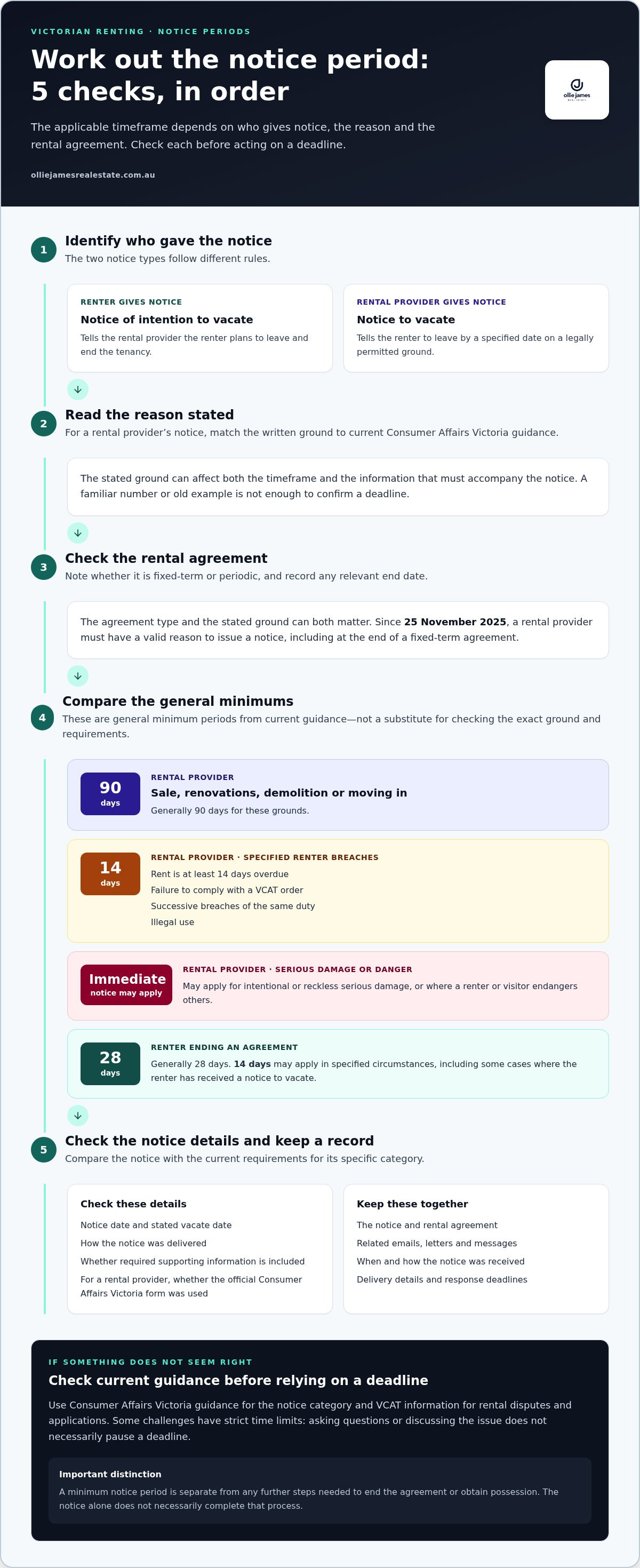
To work out which timeframe may apply, check these details in order:
- Who gave the notice? A renter’s notice of intention to vacate follows different rules from a rental provider’s notice to vacate.
- What reason is stated? Match the ground written on the notice to the relevant category in Consumer Affairs Victoria’s current guidance.
- What type of agreement applies? Check whether it’s fixed-term or periodic, and note any relevant end date.
The periods below are general minimums from the current guidance, not a substitute for checking the exact ground and requirements.
- Rental provider, sale, renovations, demolition or moving in: generally 90 days for these grounds.
- Rental provider, specified renter breaches: 14 days for rent at least 14 days overdue, failure to comply with a VCAT order, successive breaches of the same duty, or illegal use.
- Rental provider, serious damage or danger to others: an immediate notice may apply for intentional or reckless serious damage, or where a renter or visitor endangers others.
- Renter ending an agreement: generally 28 days; 14 days may apply in specified circumstances, including some cases where the renter has received a notice to vacate.
Which details can change the applicable notice period?
The ground and agreement type can affect the timeframe and the information that must accompany the notice. Rental providers must use the official Consumer Affairs Victoria form. Check the date on the notice, the stated vacate date, how it was delivered and whether required supporting information is included. Compare those details with the current rules for the specific category. A minimum notice period is separate from any further steps needed to end the agreement or obtain possession, so don’t assume the notice alone completes that process.
For a practical check, write down the stated reason and dates, then compare them with Consumer Affairs Victoria’s current guidance rather than relying on an old example. Bendigo rental providers can find information about Bendigo property management and tenancy administration.
Next Steps After a Notice to Vacate in Victoria
A notice can feel confronting, particularly when the reason or deadline isn’t clear. Keep the notice, rental agreement and related messages together. Make a note of when and how the notice was received, the stated vacate date and any response deadlines. Save copies of emails, letters and delivery details so you can refer to the same record if questions arise.
If the notice seems invalid or the timing may be wrong, check the current notice guidance on Consumer Affairs Victoria and information about rental disputes and applications on VCAT. Some challenges have strict time limits, so don’t assume that asking questions or discussing the issue pauses a deadline. Confirm which process applies to your reason and circumstances.
When should you seek further guidance about a Victorian notice?
Seek situation-specific guidance if the stated ground is unclear, the dates conflict, you’re unsure how the notice was served, or the deadline is close. The notice to vacate period Victoria requires can depend on the category and details, so have your documents ready when seeking help. A property manager can assist with rental-management steps and communication, but doesn’t replace legal advice about your rights or a dispute.
For renters and rental providers in Bendigo, Kangaroo Flat, Junortoun, Epsom, Eaglehawk, Strathfieldsaye, Strathdale, Kennington, Golden Square, California Gully, Maiden Gully and Marong, local property management can help organise practical tenancy processes and communication. Find out more about rental property management in Bendigo.
Take your next step with clarity
The right notice period depends on who gives notice, the reason and the rental agreement, so check those details before acting on a deadline. Keep the notice and related records together, and use current Consumer Affairs Victoria or VCAT guidance if the grounds, dates or service are unclear. A property manager can help with rental-management steps, but isn’t a substitute for legal advice.
For rental providers and renters across Bendigo and Central Victoria, Ollie James Real Estate provides property management that includes legislative compliance oversight. The team supports local rental properties in Bendigo, Kangaroo Flat, Junortoun, Epsom, Eaglehawk, Strathfieldsaye, Strathdale, Kennington, Golden Square, California Gully, Maiden Gully and Marong.
Understanding the notice to vacate period Victoria rules require is a useful first step. For practical local support with your rental property, explore Ollie James Real Estate’s property management services.
Frequently Asked Questions
How many days’ notice does a rental provider need to give in Victoria?
There isn’t one fixed period. For many grounds, including sale, renovations, demolition or the provider or a family member moving in, the minimum is 90 days. Certain renter breaches generally require 14 days, while intentional or reckless serious damage or danger to others can lead to immediate notice. The notice to vacate period Victoria requires depends on the stated ground and current rules, so check the relevant category before relying on a date.
How much notice does a renter need to give before moving out in Victoria?
A renter generally needs to give 28 days’ notice of their intention to vacate, whether the agreement is fixed-term or periodic. A 14-day period may apply in specific circumstances, including some cases where a renter has received a notice to vacate. Check the current Consumer Affairs Victoria guidance for the reason you’re leaving, and make sure your notice clearly states your intended vacate date.
Can a rental provider issue a notice to vacate during a fixed-term agreement?
Yes, a rental provider can issue a notice during a fixed-term agreement if a valid legal ground applies and the notice meets the relevant requirements. Since 25 November 2025, providers can’t issue a no-fault notice, including simply because a fixed term is ending. If a renter receives a no-fault notice during a fixed term, they can give 14 days’ notice of intention to vacate before the fixed term ends.
What can I do if I think a notice to vacate is invalid?
Keep the notice, rental agreement and related messages, and record service details and deadlines. Check the stated ground and dates against current Consumer Affairs Victoria guidance. If disputing the notice, review VCAT’s application process promptly, as some grounds have a 30-day application window. These Victorian rules apply in Bendigo, Kangaroo Flat, Junortoun, Epsom, Eaglehawk, Strathfieldsaye, Strathdale, Kennington, Golden Square, California Gully, Maiden Gully and Marong.


