

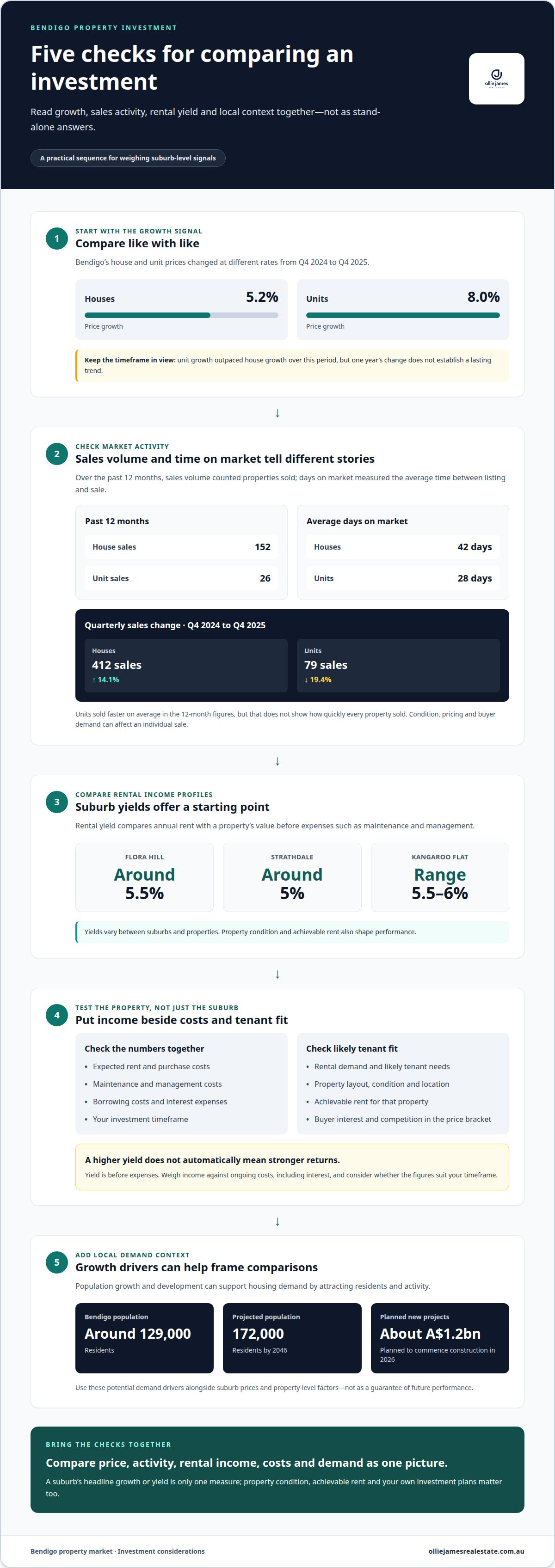
The suburb with the highest price isn’t automatically Bendigo’s strongest investment choice. From Q4 2024 to Q4 2025, house prices grew by 5.2% and unit prices by 8.0%. Whether Bendigo is a good place to invest depends on more than headline growth.
It’s understandable to want a clear picture before making a major property decision. This guide compares prices and market activity across Bendigo suburbs, explains factors that may support capital growth, and outlines what to consider when choosing an investment. Rental demand and sales conditions also add useful context to suburb-level figures.
Key Takeaways
- Compare suburb price ranges to narrow your search to locations that suit your investment budget and priorities.
- Use sales volumes and days on market to understand how quickly properties are moving and how active the market is.
- Weigh rental demand, yield and local growth drivers together rather than relying on one measure when assessing a suburb.
- Consider local guidance on buying, selling or managing a property to make your next step clearer.
Which Bendigo suburbs are best for capital growth?
Bendigo property price trends by suburb vary between houses and units, and between inner, middle-ring and outer areas.
House Median Prices and Capital Growth
The median house price is the midpoint of house sale prices in a market.
Unit Median Prices and Capital Growth
The median unit price is the midpoint of unit sale prices. Unit growth outpaced house growth over the same period, but one year’s change does not establish a lasting trend. Use the citywide median as a reference, then compare a unit’s suburb, condition and features.
Growth Across Inner, Middle-Ring and Outer Areas
These area labels describe locations relative to Bendigo’s centre. The differences help frame entry costs, but a lower price alone does not predict future performance or make an area the strongest growth prospect.
Infrastructure and Population Growth
Population growth and development can support housing demand by attracting residents and activity. Bendigo’s population is around 129,000, with projections reaching 172,000 residents by 2046. About A$1.2 billion in new projects was planned to commence construction in 2026. Reading Bendigo property price trends by suburb alongside these potential demand drivers can help frame suburb comparisons.
Property sales volumes and days on market
Sales volume is the number of properties sold during a stated period, while days on market measures the average time between listing and sale. Together, these figures describe activity in Bendigo’s property market, but they measure different things.
Over the past 12 months, Bendigo recorded 152 house sales and 26 unit sales. Houses spent an average of 42 days on the market during that period, compared with 28 days for units. The shorter unit timeframe suggests units sold faster on average, but it doesn’t show how quickly every property sold. Condition, pricing and buyer demand can all affect an individual sale.
Quarterly figures offer another view of market activity. In Q4 2025, Bendigo house sales increased by 14.1% to 412, compared with Q4 2024. Unit sales moved in the opposite direction, declining by 19.4% to 79 over the same comparison. This contrast shows why property type matters when interpreting changes in sales activity across Australia.
For buyers, higher house sales may mean more properties are changing hands, while fewer unit sales can indicate a quieter segment. For sellers, days on market provides context for setting expectations, not a guaranteed sale timetable. Read these figures alongside suburb-level prices and the property’s condition, presentation and asking price.
If you’re preparing to sell, a free property value update can help put your home’s position in the local market into context.
Suburb selection and investment considerations
An investment property’s suitability depends on its price, rental income, demand and ongoing costs. In Victoria, weigh these factors together rather than choosing a suburb on yield alone. Rental yield compares annual rent with a property’s value before expenses such as maintenance and management.
Suburb figures show different income profiles. Rental yields can vary between suburbs and properties, so compare them with the costs and expected rent for each investment. Flora Hill is around 5.5%, while Strathdale is around 5%. Kangaroo Flat ranges from 5.5% to 6%. These figures help frame comparisons, but property condition and achievable rent also shape an investment’s performance.
Demand matters too. These measures describe different parts of the rental market, so assess them alongside the property type and likely tenant demand. Buyer interest can also vary between suburbs and price brackets, affecting competition for suitable properties.
Before deciding, compare expected rent with purchase costs, maintenance needs and your borrowing costs. Interest expenses affect cash flow, so a higher yield doesn’t automatically mean stronger returns. Check how the property’s layout, condition and location match likely tenant needs, then consider whether the numbers suit your investment timeframe. For a more property-specific view, review your investment options before buying.
Ollie James Real Estate
Ollie James Real Estate can help connect Bendigo’s suburb-level market information with your property plans. If you’re considering an investment, its investment property pre-purchase assessment can support your evaluation before buying. Property Management and Tenant Selection and Vetting can help with managing a rental and selecting tenants. Residential Property Sales and Land Sales are relevant when buying or selling in the region.
Whether you’re comparing suburbs or have a specific property in mind, a local conversation can help clarify your next step. Contact Ollie James Real Estate to discuss your Bendigo property plans.
Make your next Bendigo property move with clarity
Use Bendigo property price trends by suburb as a starting point, then focus on a property that fits your goals, budget and timeframe. Past suburb performance can inform your thinking, but it can’t tell you whether a particular home or block suits your plans.
Before taking the next step, consider how you would respond if rental income, borrowing costs or your plans changed. Clear priorities can help you assess options steadily instead of feeling pushed by market noise.
Whether you’re considering a purchase, preparing to sell or exploring land, Ollie James Real Estate can help you take a practical next step through its Residential Property Sales, Property Management and Land Sales services. Talk with Ollie James Real Estate about your property plans and move forward with greater confidence.
Frequently Asked Questions
Is Bendigo a good place to invest in property?
Bendigo may suit investors whose plans align with local rental demand, property type and holding timeframe. The right choice depends on more than a suburb’s headline growth: consider whether a property can attract suitable tenants and whether its ongoing costs fit your budget. Compare Kangaroo Flat, Epsom and Marong against your investment priorities before deciding.
What are the latest median house prices by suburb in Bendigo?
What are the latest median unit prices by suburb in Bendigo?
Unit prices can vary with location, condition, size and the mix of properties sold. For a meaningful comparison, look at similar units in the same suburb, such as central Bendigo or Kangaroo Flat, rather than treating the citywide median as an expected price in every area.
Which Bendigo suburbs have had the strongest property price growth over the past 12 months?
The strongest reported 12-month growth was for Bendigo units, which rose 8.0% from Q4 2024 to Q4 2025; houses rose 5.2% over that period. These are citywide results, not a suburb ranking. They don’t establish which suburb led growth. For suburb comparisons, separate houses from units and compare like-for-like sales rather than assuming the broader trend applied evenly.
How have Bendigo suburb property prices changed over the past five years?
To assess a five-year suburb trend, compare median prices for the same property type and location at matching points five years apart. The latest annual growth figures show shorter-term movement, not the cumulative change over five years. Account for changes in the properties sold, too: a shift towards larger or renovated homes can affect a suburb’s median.


