
A property's rent alone can't tell you whether it is a sound investment. To understand how to calculate return on investment for property, subtract the investment’s total cost from its current value, then divide the difference by the total cost and express the result as a percentage. For a rental property, include ongoing expenses and income too, so the figure reflects more than a change in value.
It is easy to focus on rental income, but operating costs and cash flow affect what an investment actually returns. This guide explains how to include those costs, calculate net operating income and understand how the capitalisation rate relates to ROI. You can assess the figures together when considering a property or reviewing one you already own.
Key Takeaways
- Include purchase and ongoing costs in your calculations to build a more realistic view of an investment’s return.
- Separate rental income from cash flow after expenses and finance costs to see what the property contributes over time.
- Use net operating income and capitalisation rate to assess operating performance alongside total ROI.
- A pre-purchase assessment can help you evaluate a property’s investment potential before deciding whether to proceed.
What is property investment ROI (Return on Investment)?
Property ROI measures the return against the money invested, including costs that simple rent figures can miss. For a Bendigo investment, the result depends on the calculation’s assumptions and which costs it includes.
Purchase and refurbishment costs
Purchase and refurbishment costs are upfront amounts that add to the investment’s initial cost. Including them matters because a calculator that uses only the purchase price can overstate ROI. Account for the purchase price and necessary work before renting the property, then note which other acquisition or selling costs the calculator excludes. When staging or renovating regional properties, logistical expenses such as booking self storage units Murray Bridge to store furniture or building materials also contribute to initial outlays. For example, a $600,000 property rented for $450 per week produces a different return once upfront costs are included.
Maintenance and running costs
Running costs are recurring expenses involved in operating a rental property, such as repairs, insurance, rates and property management. They matter because rental income is not the same as the money you retain. Record costs over the same period as the rent, whether monthly or annually, and allow for maintenance rather than assuming the property will remain in its purchase condition. This gives you a more useful view of the return while you own it.
Deductions from rental yield
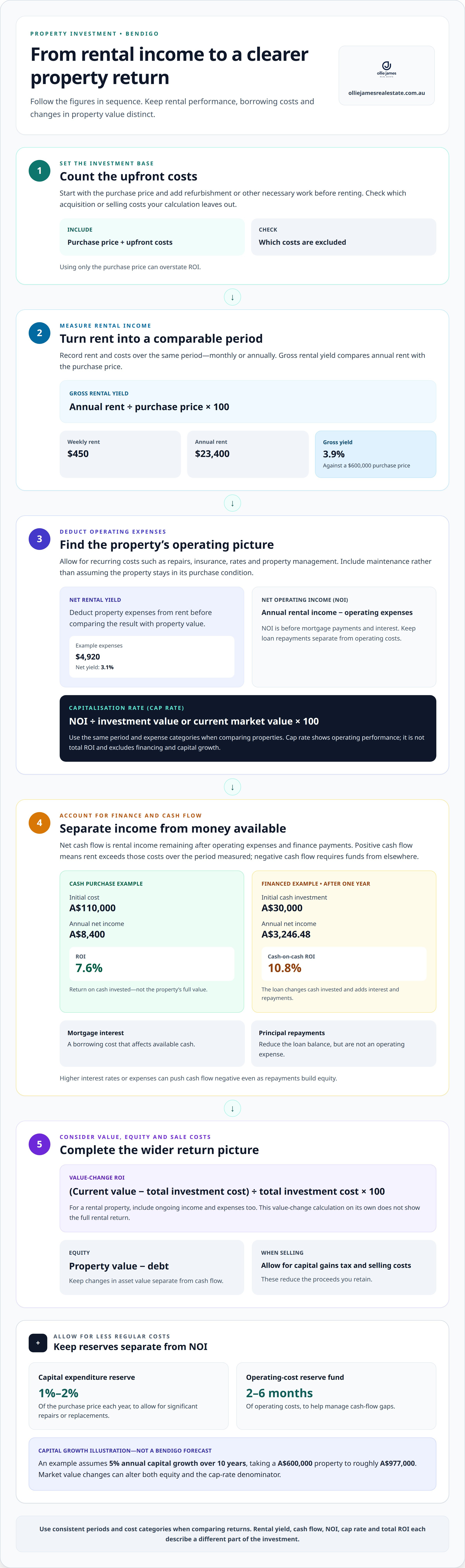
Gross rental yield is annual rent divided by purchase price, multiplied by 100. At $450 per week, annual rent is $23,400; against a $600,000 purchase price, gross yield is 3.9%. Net yield deducts property expenses from rent before comparing the result with the property value. Costs of $4,920 reduce the example’s net yield to 3.1%. Compare property yields with shares, bonds or other investments using consistent periods and costs, while recognising their returns arise in different ways.
Cash flow and holding costs
Net cash flow is rental income remaining after operating expenses and finance payments. Mortgage interest is a borrowing cost, while principal repayments reduce the loan balance. Both affect available cash, but principal is not an operating expense. Capital gains tax and selling costs reduce the proceeds you retain when you sell, so include them when estimating total ROI. Holding costs continue during vacant periods, so account for assumed occupancy and loan payments in your calculations.
Operating expenses and cash flow
Cash flow shows what remains from rent after operating expenses and mortgage payments. To calculate property ROI accurately, separate this income from changes in asset value and equity.
For a cash purchase, add the purchase price and upfront costs, then compare annual net income with that investment. In one example, the initial cost is A$110,000 and annual net income is A$8,400, producing a 7.6% ROI. The percentage describes the return on cash invested, not the property’s full value.
With a mortgage, cash-on-cash return compares annual cash flow with the investor’s cash contribution. In a financed example, A$3,246.48 of annual net income divided by an initial A$30,000 investment gives a 10.8% ROI after one year. The loan changes the cash invested and adds interest and repayments. Higher interest rates or expenses can push cash flow negative, even as repayments build equity.
Positive cash flow means rent exceeds operating expenses and finance payments over the period measured. Negative cash flow requires funds from elsewhere. To calculate return on investment for property, keep asset value separate: equity is the property’s value less debt. A property value update can help inform that part of the calculation. Use consistent periods and cost categories when comparing percentages, so the result reflects performance rather than different assumptions.
Capitalization rate and net operating income
Net operating income (NOI) is annual rental income minus operating expenses, before mortgage payments and interest. The capitalisation rate, or cap rate, is NOI divided by the property’s investment value or current market value, expressed as a percentage. Together, these figures show operating performance without mixing it with borrowing choices.
For a fair comparison, use the same period and expense categories for each property. Include regular operating costs, such as maintenance and property management, but keep loan repayments separate from NOI. A cap rate is not total ROI: it excludes financing and capital growth, and does not show how much cash you contribute or retain.
Capital expenditure needs separate attention. Significant repairs or replacements can arrive irregularly, so an annual reserve of 1% to 2% of the purchase price helps account for future spending. A reserve fund covering two to six months of operating costs can also help manage cash-flow gaps. These allowances affect the wider investment picture, even when they sit outside the NOI calculation.
Capital growth is another potential component of total return, but it is distinct from rental income. One worked example assumes 5% annual capital growth over 10 years, taking a A$600,000 property to roughly A$977,000. Treat this as an illustration, not a forecast for Bendigo: market value changes can alter both equity and the cap-rate denominator. For a purchase decision, arrange an investment property pre-purchase assessment to consider the property’s figures before committing.
Ollie James Real Estate: Investment property pre purchase assessment
Ollie James Real Estate offers an investment property pre-purchase assessment for buyers weighing a property’s likely income against its costs. It’s a useful next step when you’ve calculated rental yield, cash flow and capitalisation rate but want to consider those figures in the context of a specific purchase. The assessment can help bring the investment decision into clearer focus before you commit, alongside the assumptions behind your calculations. Property returns depend on both the numbers and the property being considered, so separating expected rental income from ongoing expenses and finance costs is important. If you’re considering an investment in Bendigo or surrounding regional areas, contact Ollie James Real Estate to discuss an investment property pre-purchase assessment.
Make your next property decision with clarity
Knowing how to calculate return on investment for property gives you a useful framework, but your next decision should reflect your plans for the asset. Before committing, consider whether you prioritise rental income, long-term ownership or the flexibility to sell. That choice helps determine which figures matter most.
Ollie James Real Estate supports property decisions through Residential Property Sales, Property Management and Land Sales, as well as investment property pre-purchase assessments. If you’re weighing up a purchase, discuss how the property may fit your investment goals and ownership plans. Contact Ollie James Real Estate to talk through your next step. A clear plan can help you move forward with greater confidence.
Frequently Asked Questions
What is a ‘good’ rental yield?
There is no single rental yield that makes a property a good investment. Assess yield alongside operating costs, finance payments, your expected holding period and potential capital growth. In Bendigo, local demand and property characteristics can vary across Kangaroo Flat, Junortoun, Epsom, Eaglehawk, Strathfieldsaye, Strathdale, Kennington, Golden Square, California Gully, Maiden Gully and Marong. A higher yield alone does not show which property best suits your goals.
What makes one property's ROI beat another?
ROI can improve with a lower total investment, higher rental income, lower ongoing expenses or an increase in property value. The timing of income and costs matters too: an unexpected repair or vacancy can reduce returns over your chosen period. Compare properties using the same holding period and cost assumptions, then consider whether the resulting income and risk suit your investment plans.
How do you calculate net rental yield after expenses in Australia?
Calculate annual rent after deducting the property’s operating expenses, then divide that net income by the property’s value and multiply by 100. For example, include relevant costs such as repairs, insurance, rates and property management in the expense total. Use rent and costs from the same period, and keep loan principal repayments separate from operating expenses to make comparisons clearer.
What is the formula for property return on investment including capital growth and rental income?
Add rental income received during the holding period to the change in property value, then subtract investment costs. Divide the resulting net return by the initial investment and multiply by 100 to express ROI as a percentage. Include relevant purchase, holding and selling expenses, and use the same period for income, costs and value change. This combines income and capital movement in one measure.
Which costs should be included when calculating property investment returns in Australia?
Include purchase and refurbishment costs, along with ongoing expenses such as maintenance, insurance, rates and property management. For a financed property, account for interest and loan payments when assessing cash flow. If you are calculating the return from a sale, include selling costs as well. Assign each cost to the period when it applies, and distinguish operating expenses from loan principal repayments and capital expenditure.


