

Could a faded curtain be ordinary wear, while a small tear counts as damage? At the end of a tenancy, the difference can feel unclear, especially when a bond claim is involved. This fair wear and tear guide for rentals VIC explains why the answer depends on the property’s starting condition, how it was used and what the records show.
It’s understandable to worry that normal deterioration could be treated as renter-caused damage, or that a condition report won’t tell the whole story. Clear, dated evidence can help put a disagreement in context. This guide covers common examples, the separate expectation to leave a home reasonably clean, and the value of entry and exit reports, photographs and communication. If a rental condition dispute remains unresolved, you’ll also find a measured next step for Victoria, without assuming every mark has a simple answer.
Key Takeaways
- Use the property’s starting condition, normal use and the specific change to assess whether an issue may be wear or damage.
- This fair wear and tear guide for rentals VIC shows how to compare condition reports, dated photos and other records when a detail is disputed.
- Keep your discussion calm and specific by identifying the item, the change in question and the evidence you’re relying on.
- If you can’t resolve a bond or condition disagreement through discussion, learn which Victorian processes may be relevant to your circumstances.
Fair wear and tear in Victorian rentals: what it means and what it does not
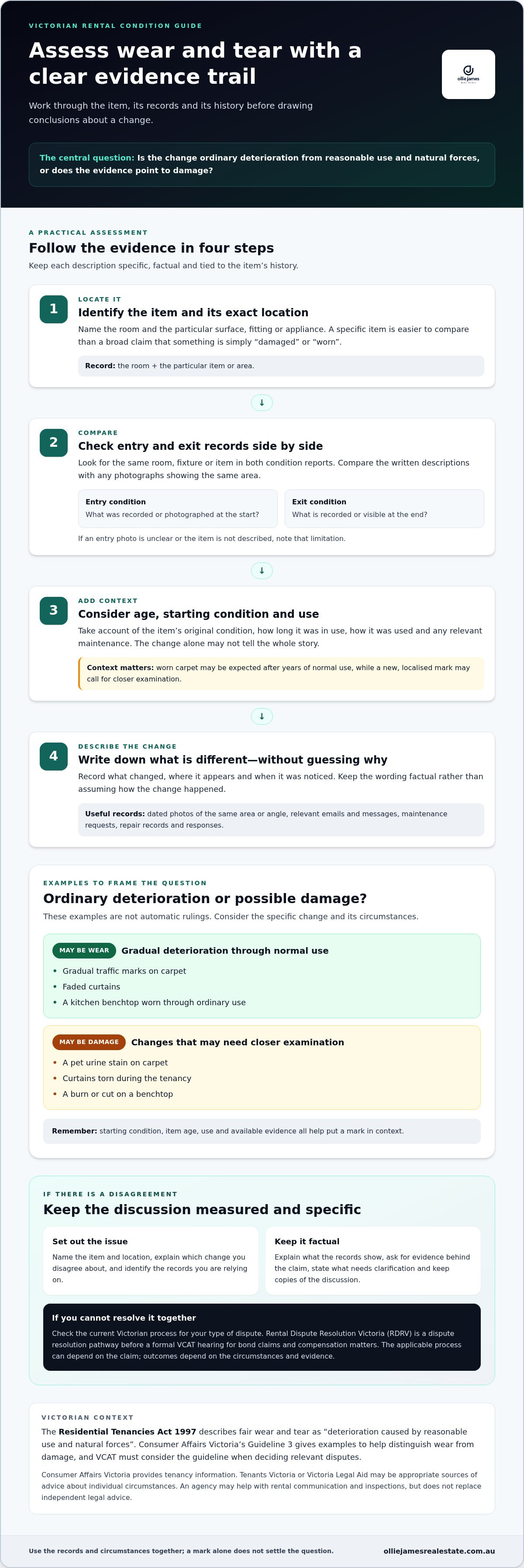
Fair wear and tear is ordinary deterioration that happens through normal use over time. It isn’t the same as damage: a home can show signs of everyday living without a renter having caused avoidable harm. The distinction can depend on the item’s condition at the start of the tenancy, how it was used and what evidence is available.
In Victoria, the Residential Tenancies Act 1997 describes fair wear and tear as “deterioration caused by reasonable use and natural forces”. Consumer Affairs Victoria’s Guideline 3 gives examples to help distinguish wear from damage, and VCAT must consider the guideline when deciding relevant disputes. For a general explanation of the term, see this wear and tear definition; Victorian rental decisions also depend on the Act, guidelines and evidence.
Everyday deterioration or renter-caused damage: how to distinguish them
Examples can help you frame the question, but they aren’t automatic rulings. Consider the specific change and its context.
- Everyday deterioration: gradual traffic marks on carpet, faded curtains or a kitchen benchtop worn through ordinary use may be consistent with fair wear and tear.
- Possible damage: a carpet with a pet urine stain, curtains torn during the tenancy, or a benchtop burn or cut may point to damage rather than ordinary deterioration.
Look at the item’s age and starting condition as well as the change itself. Worn carpet may be expected after years of normal use, while a new, localised mark may call for closer examination. How the item was used and what caused the deterioration matter too. A fair wear and tear guide for rentals VIC should help renters and residential rental providers assess the circumstances, not assume responsibility from a mark alone.
How to assess fair wear and tear using rental condition evidence
A clear comparison is more useful than a broad claim that something is “damaged” or “worn”. Work through the item and its history in order, keeping the description factual:
- Identify the item: Note the room and the particular surface, fitting or appliance.
- Compare the records: Check what the entry and exit condition reports say and whether photographs show the same area.
- Consider use and age: Take account of the item’s original condition, how long it was in use and any relevant maintenance.
- Describe the change: Record what is different, where it appears and when it was noticed, without assuming how it happened.
Evidence helps establish both the property’s starting condition and the changes that occurred during the tenancy. Dated photos can add useful detail, particularly when they show the same angle or area at different points. Keep relevant emails or messages between the renter and residential rental provider, along with maintenance requests, repair records and responses. These can help explain whether an issue was reported or work took place.
What to compare in entry and exit condition reports
Look at the same room, fixture or item in both reports. Compare the written description with any available images, noting a specific difference rather than relying on a general impression. If an entry photo is unclear or the item isn’t described, record that limitation too. The Tenants Victoria guide to repairs and fair wear and tear provides further renter-focused context on maintenance and damage.
This practical approach can bring clarity to a fair wear and tear guide for rentals VIC, though the records need to be considered alongside the circumstances. For local rental support, Ollie James Real Estate provides rental inspections in Central Victoria.
Resolving Victorian rental wear and tear disputes
A bond disagreement can feel stressful, but a clear, measured conversation is a useful place to start. Write to the other party with the item and location, the change you disagree about, and the records you’re relying on. Keep the message factual: explain what the entry and exit records show, ask for any evidence behind the claim, and state what you think needs clarification. Keep copies of the discussion.
Bond claims and rental condition disputes depend on the circumstances, evidence and relevant Victorian processes. If you can’t resolve the issue together, check the current steps for your type of dispute. For bond claims and compensation matters, Rental Dispute Resolution Victoria (RDRV) is a dispute resolution pathway before a formal VCAT hearing. The process that applies can depend on the claim, so avoid assuming a particular result.
Where Victorian renters and rental providers can look for guidance
Consumer Affairs Victoria provides information about problems during a tenancy, including ways to understand and address rental issues. For advice about your individual circumstances, consider an appropriate legal service such as Tenants Victoria or Victoria Legal Aid. An agency may help with rental communication and inspections, but it doesn’t replace independent legal advice.
If your question relates to a tenancy managed locally, Ollie James Real Estate’s property management support may be a practical point of contact for rental communication. For landlords and renters seeking local context, explore Bendigo rental property management. This fair wear and tear guide for rentals VIC can help you organise the issue before deciding what information or support to seek next.
Make your next tenancy step with greater confidence
A rental condition concern can be a useful prompt to strengthen communication and record-keeping for the rest of a tenancy. If a question is still unsettled, take time to understand the relevant Victorian process and seek advice suited to your circumstances. This fair wear and tear guide for rentals VIC is a starting point, not a substitute for independent legal guidance.
For practical local rental support, Ollie James Real Estate offers Rental Inspections and personalised, locally informed support across Central Victoria. Whether you’re a renter seeking clarity about an inspection or a residential rental provider managing a tenancy, a considered conversation can help you decide what to do next.
Explore local rental support in Central Victoria, and take your next step with a clearer sense of direction.
Frequently Asked Questions
These answers offer general guidance for renters and residential rental providers across Bendigo, Kangaroo Flat, Junortoun, Epsom, Eaglehawk, Strathfieldsaye, Strathdale, Kennington, Golden Square, California Gully, Maiden Gully and Marong.
Does fair wear and tear include faded paint?
Gradual paint fading may be ordinary deterioration, but it isn’t automatically fair wear and tear. The cause, extent, time involved and paint’s condition at the tenancy’s start all matter. Fading over time differs from a mark caused by an identifiable incident, such as a scrape while moving furniture. Compare available condition records and check current Consumer Affairs Victoria guidance before drawing a conclusion.
Can a rental provider deduct fair wear and tear from a renter’s bond?
Ordinary deterioration shouldn’t automatically be treated as renter-caused damage in a bond claim. Whether a claim is justified depends on the particular facts, supporting evidence and applicable Victorian bond process. If you disagree with a proposed deduction, ask for the basis of the claim in writing and check current Consumer Affairs Victoria information. For advice about your circumstances, consider seeking legal help.
Can a renter be charged for professional cleaning at the end of a tenancy?
Professional cleaning isn’t automatically required in every tenancy. Cleaning is separate from fair wear and tear, so consider the property’s cleanliness at the relevant time, its records and the Victorian requirements that apply. For example, a cleaning disagreement may concern a specific area rather than the whole property. Check current Consumer Affairs Victoria guidance for the circumstances and requirements relevant to your tenancy.
What if the entry condition report does not show the item clearly?
A condition report is one piece of evidence, not the only record that may help explain an item’s condition. Dated photos, messages about the item, maintenance records or other relevant documents may provide useful context. Write a factual account of what you observed and when, and keep copies of supporting records. Check current Victorian guidance, as no single document guarantees how evidence will be assessed.


