

If a tenant says rent is paid through Friday, can your records show exactly how you reached the same answer? Knowing how to write a rental ledger can help turn scattered payments into a clear, checkable record.
It’s understandable to feel unsure about which dates, amounts and payment details belong in the ledger, especially when you’re trying to confirm whether rent is up to date. A useful ledger is more than a list of amounts: it’s a reconciled timeline that helps landlords and tenants spot missing, late or incorrectly recorded payments.
This guide explains what to record, how to keep entries accurate and how to check the running balance. You’ll also learn when professional property management, including rent collection and financial reporting, can help keep rental records consistent in Bendigo and Central Victoria, including Kangaroo Flat, Junortoun, Epsom, Eaglehawk, Strathfieldsaye, Strathdale, Kennington, Golden Square, California Gully, Maiden Gully and Marong.
Key Takeaways
- A rental ledger gives landlords and tenants a shared timeline for checking rent history and resolving discrepancies.
- Follow a clear process for how to write a rental ledger, from setting up tenancy details to recording each payment and updating the paid-to date.
- Update entries promptly, keep supporting records and review the ledger regularly to catch gaps or errors.
- For Victorian record-keeping duties and timeframes, refer to current Consumer Affairs Victoria guidance; property management can also help landlords maintain consistent rent records.
What a rental ledger records and why each entry matters
A rental ledger records rent transactions and the period each payment covers. It creates a chronological account that landlords and tenants can use to check payment history, see the current paid-to date and investigate discrepancies without relying on memory alone.
In a busy Australian residential rental market, clear records can make routine questions easier to resolve. A practical ledger identifies the rental provider and tenant, the rental address, payment date and amount, payment method or reference, rent period covered, paid-to date and any relevant notes. These details connect each transaction to the right tenancy and time period.
Which dates and payment details should a rental ledger show?
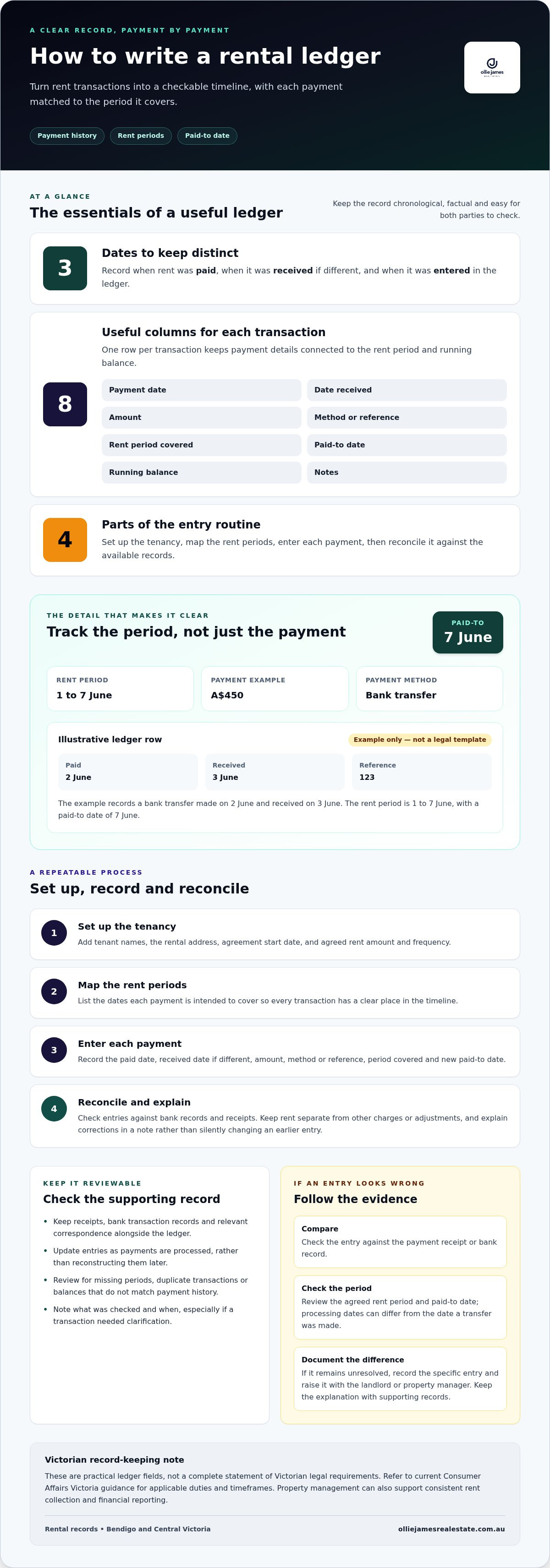
Keep the date the rent was paid distinct from the date it was received or entered. For example, a tenant might make a bank transfer on 2 June, while it appears in the account on 3 June and is added to the ledger later. Recording the relevant dates separately helps explain processing delays and keeps the timeline transparent.
The paid-to date shows the last day covered by rent recorded as paid. If a weekly payment covers 1 to 7 June, the ledger should show that period and a paid-to date of 7 June. This makes it easier to see which period the next payment needs to cover, rather than simply comparing totals.
When deciding how to write a rental ledger, use notes to clarify unusual entries, such as a payment shortfall, an adjustment or a reference that helps identify a transfer. Keep entries factual and easy for both parties to interpret. These are practical record-keeping fields, not a complete statement of Victorian legal requirements. For current duties or timeframes, refer to Consumer Affairs Victoria guidance before relying on a particular rule.
How to write a rental ledger: record and reconcile each payment
A consistent entry process makes a ledger easier to check and correct. Set it up in order, then use the same method for every transaction:
- Set up the tenancy: Add the tenant names, rental address, agreement start date and agreed rent amount and frequency.
- Map the rent periods: List the dates each rent payment is intended to cover. This gives each payment a clear place in the timeline.
- Enter each payment: Record the date paid, date received if different, amount, payment method or reference, period covered and new paid-to date.
Next, reconcile each entry against available bank records and receipts. Record rent payments separately from other charges or adjustments, and explain any correction in a note rather than silently changing an earlier entry. If a payment is short or covers an unexpected period, record what arrived and flag the difference for follow-up.
A simple spreadsheet layout for rent payments
Use one row per transaction, with columns for payment date, received date, amount, method or reference, rent period, paid-to date, running balance and notes. Keep dates in one format and amounts in Australian dollars. An illustrative row might read: 2 June | 3 June | A$450 | bank transfer, ref 123 | 1 to 7 June | 7 June | balance updated | received next day. This is an example for clarity, not a legal template.
If an entry needs correcting, preserve the original information and add a dated note explaining the change. NSW Fair Trading’s rent record guidance applies to NSW, so it should not be treated as Victorian legal advice. For landlords who want support with consistent rent records, professional property management can include rent collection and financial reporting.
Keep a Victorian rental ledger clear, current and easy to review
A ledger is most useful when it’s updated as payments are processed, not reconstructed weeks later. Keep receipts, bank transaction records and relevant correspondence alongside it, then review entries regularly for missing periods, duplicate transactions or balances that don’t match the payment history. In Victoria, refer to current Consumer Affairs Victoria guidance for applicable record-keeping duties and any timeframe for providing a ledger copy. Requirements can change, so verify the current advice before relying on a specific obligation.
A consistent routine also makes it easier for both parties to follow the record. Note what was checked and when, particularly if a transaction needed clarification. This creates a useful trail without assuming that a difference in dates or balances automatically means rent is unpaid.
What to do when a rental ledger entry looks wrong
Start with the details. Compare the entry with the payment receipt or bank record, then check the agreed rent period and paid-to date. A transfer may show a different processing date from the date it was made, so review the full transaction before drawing a conclusion. If the discrepancy remains, document the specific entry and raise it with the landlord or property manager. Keep any explanation with the supporting records.
For landlords, professional property management can support consistent rent collection and financial reporting. Ollie James Real Estate provides property management in Bendigo and Central Victoria. The article “Rental Property Management in Bendigo: A 2026 Guide for Tenants and Landlords” explores the broader role of management and how writing a rental ledger fits into clear rental record-keeping.
Make rental record-keeping part of a confident next step
A clear rental record gives both parties a steadier starting point for future conversations. For landlords, deciding how to write a rental ledger is one part of setting up dependable property management. For tenants, understanding the record makes it easier to discuss a payment question calmly and specifically.
If managing rent records alongside the rest of your investment is becoming difficult, local support can help you take a more consistent approach. Ollie James Real Estate is an independent, family-owned agency with over 17 years of local industry experience. Its property management includes rent collection and financial reporting, helping landlords keep financial information organised.
Explore property management support in Bendigo and take a more organised approach to managing your rental. A confident next step starts with a record you can understand and rely on.
Frequently Asked Questions
What information should a rental ledger include?
Include enough detail to identify the tenancy and make each rent entry understandable: tenant and rental provider names, property address, the relevant rent period, transaction date, amount, payment reference and current balance. If you're learning how to write a rental ledger, also keep rent distinct from bond, utilities or other charges, so a reader can tell which entries relate specifically to rent.
Can I create a rental ledger in Excel or Google Sheets?
Yes. A spreadsheet can work well if you use consistent columns, protect access to tenant information and keep a backup. In Google Sheets, version history can help you review edits; in Excel, save dated copies or use a secure backup location. Choose a format that lets you find a transaction quickly and share a legible copy when needed.
How do I check whether the rent paid-to date is correct?
Start with the rent frequency and payment schedule in the rental agreement, then trace the recorded payments forward from the last confirmed paid-to date. Check that each payment has been applied to the intended period and that no period has been counted twice or skipped. If dates still don’t align, compare the calculation with the transaction records before treating the difference as arrears.
Can a tenant request a copy of their rental ledger in Victoria?
Yes, a tenant can request a copy from their landlord or property manager, ideally in writing and with the dates they need. If an entry is unclear, identify the transaction and request an explanation rather than disputing the whole record. For Victorian requirements or any timeframe that may apply, refer to current Consumer Affairs Victoria guidance, as receipt rules and ledger-copy requests aren’t necessarily the same.


