

What if the most expensive part of your investment property isn't the mortgage, but a single missed safety audit? It's no secret that being a property investor in Victoria feels increasingly like walking a financial tightrope. Between the revised land tax thresholds and rising interest rates, you're likely feeling the pressure to keep your margins healthy while meeting every new legislative requirement. We understand that this weight can be heavy, especially when the rules seem to change just as you've settled into a routine. This guide provides a clear roadmap for your 2026 budget, ensuring you stay ahead of mandatory compliance without the stress of unexpected VCAT disputes. We will break down the essential landlord costs Victoria investors must track, from biennial gas and electrical checks to regional management fees, helping you move from financial uncertainty to a position of confidence and control.
Key Takeaways
- Understand the 2026 land tax thresholds and why mandatory gas and electrical safety audits are essential for maintaining legislative compliance.
- Gain clarity on the ongoing landlord costs Victoria investors face, from regional management fees to the essential marketing required for quality leasing.
- Learn why a rigorous tenant selection process is your most effective tool for avoiding the financial strain of vacancy and VCAT disputes.
- Discover how to protect your bottom line by using tax depreciation schedules to offset operational expenses and improve your annual rental yield.
Compliance and Upfront Costs in the 2026 Victorian Market
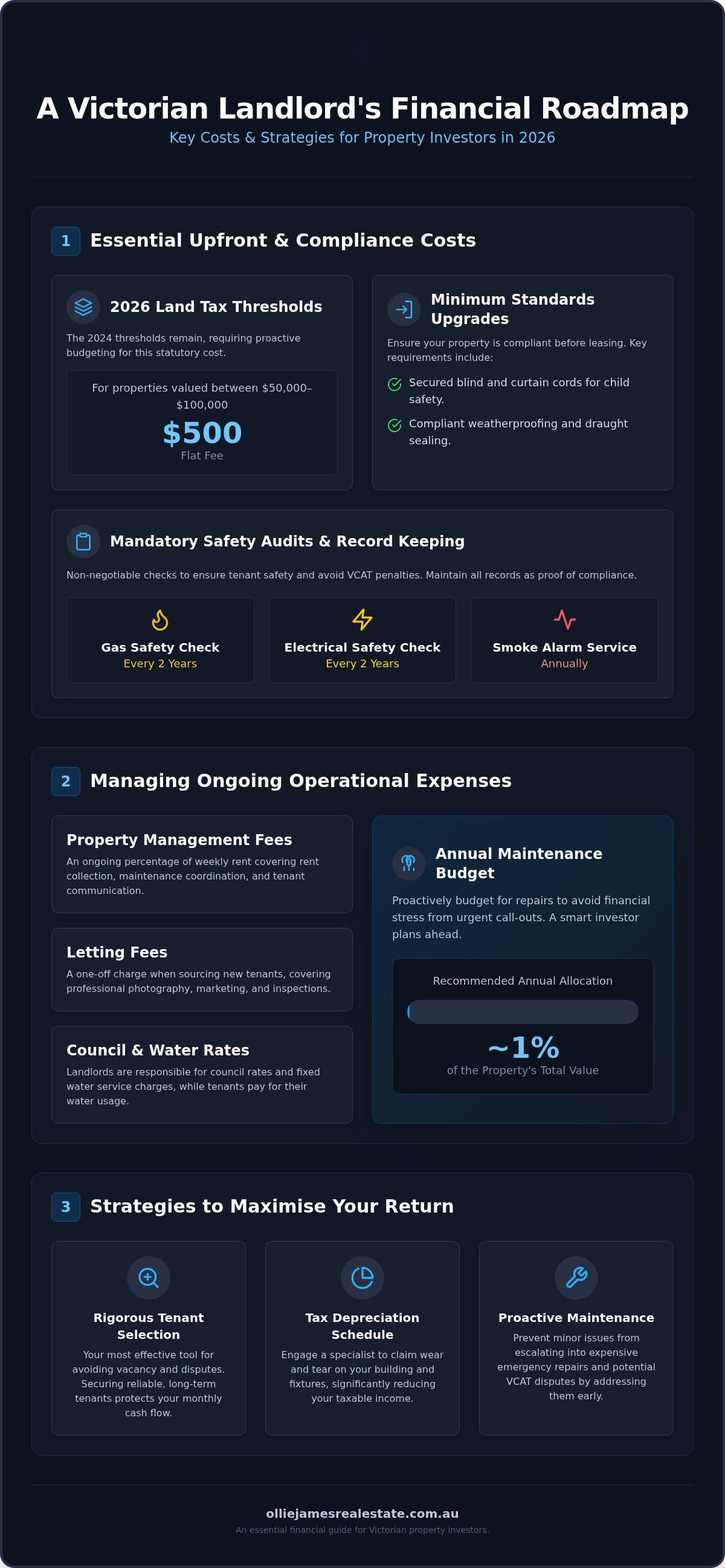
Owning an investment property in Central Victoria involves more than just collecting rent; it requires a deep commitment to safety and legal standards. The 2026 fiscal year keeps the 2024 land tax thresholds in place, meaning properties valued between $50,000 and $100,000 incur a $500 flat fee. Planning for landlord costs Victoria investors face often starts with understanding these statutory obligations before a tenant even moves in. These expenses are non-negotiable but manageable with the right local guidance.
Mandatory Safety Audits and Compliance Fees
The foundation of modern landlord-tenant law is the provision of a safe dwelling. In Victoria, you're required to complete specific checks to stay compliant:
- Gas and Electrical: Professional inspections are mandatory every two years.
- Smoke Alarms: Servicing and testing must occur annually.
- Record Keeping: You must keep evidence that the property met minimum standards when advertised.
Failing to keep these records can lead to significant penalties or complications during bond claims. Choosing expert Rental Property Management in Bendigo helps mitigate VCAT exposure by ensuring every audit is logged and every deadline is met.
Beyond safety checks, you'll need to budget for minimum standards upgrades. By 2026, every rental must feature secured blind cords and compliant weatherproofing. For regional landlords, insurance is another critical upfront cost. Local conditions like bushfire or storm risks mean your policy must be specific to Central Victoria. While these costs add up, they provide the security that your asset and tenants remain protected.
Ongoing Operational Expenses: From Management to Maintenance
Managing a rental property involves a steady stream of operational outgoings. While land tax is a significant annual hit, the month-to-month landlord costs Victoria investors encounter are often more granular. Council rates and water charges vary across the Greater Bendigo region. Rates in Epsom might differ slightly from those in Kangaroo Flat based on property valuations. In Victoria, tenants typically pay for the water they use, but the landlord remains responsible for fixed service charges. We recommend budgeting roughly 1% of the property's value for annual maintenance. This ensures you can handle urgent repairs without dipping into your personal savings.
Property Management and Letting Fees Explained
Professional oversight is the most effective way to protect your investment. Ongoing management fees, usually a percentage of the weekly rent, cover rent collection and maintenance coordination. Letting fees are separate one-off charges incurred when finding new tenants. These cover professional photography and marketing to ensure your property stands out. Following the Official Victorian renting guide helps you understand the legal boundaries of these charges and ensures you stay compliant with the Residential Tenancies Act.
Local expertise at Ollie James Real Estate ensures your property management in Kangaroo Flat is handled with integrity. We provide detailed financial reporting so your tax time is stress-free. If you're unsure about your current yield, you might benefit from a free property value update to see how your asset compares to the 2026 market. Understanding the full scope of landlord costs Victoria requires this level of local insight to remain profitable over the long term.
Minimising Risk and Maximising Your Rental Yield
While the direct landlord costs Victoria investors pay are clearly defined on a balance sheet, the emotional toll of a difficult tenancy or a long vacancy is much harder to quantify. Strategic management transforms these anxieties into predictable outcomes. We focus on rigorous tenant selection and vetting to ensure your property isn't just occupied, but respected by those who call it home. A few weeks of vacancy costs far more than a comprehensive marketing campaign. By securing reliable, long-term tenants from the start, you protect both your monthly cash flow and your long-term peace of mind.
To further improve your bottom line, you should consider engaging a specialist to prepare a tax depreciation schedule. This critical tool allows you to claim the natural wear and tear on your building and its fixtures, significantly reducing your taxable income as a landlord. When you combine these tax benefits with a proactive approach to maintenance, you prevent minor issues from escalating into expensive emergency call-out fees or VCAT disputes. Expert guidance helps you move from a state of financial uncertainty to one of quiet confidence.
Strategic Management to Protect Your Profit
Long-term tenancies remain the cornerstone of a high-yield portfolio. By identifying quality applicants through our 17 years of local expertise, you avoid the recurring re-letting fees and advertising expenses associated with high tenant turnover. This level of personalised care is why Bendigo real estate remains such a resilient choice for Victorian investors. Our deep roots in the community allow us to manage regional risks with a level of agility that larger firms cannot match. Professional management is the ultimate antidote to market volatility, ensuring your capital growth is protected while you focus on your broader financial goals.
Securing Your Investment Future in Central Victoria
While managing landlord costs Victoria investors face in 2026 requires diligence, it doesn't have to be a source of constant stress. By staying ahead of biennial safety audits and prioritising high-quality tenant selection, you transform potential risks into a stable, high-yielding asset. Our team at Ollie James Real Estate brings over 17 years of local industry expertise to every property we manage. As a family-owned and independent agency, we specialise in Victorian legislative compliance; this ensures your investment remains protected against shifting regulations. You deserve the peace of mind that comes from knowing your budget is predictable and your assets are in expert hands. Ready to gain total clarity on your portfolio? Request a free property management appraisal from our Bendigo experts today. Your journey toward a more secure and profitable investment starts with the right regional partner.
Frequently Asked Questions
How much are typical property management fees in Bendigo?
Property management fees in regional Victoria generally align with state averages, typically ranging between 5% and 10% of the weekly rent. These fees cover the essential day-to-day oversight of your asset. While the percentage is a key factor, the value lies in the specialised local knowledge that protects your yield and ensures every legislative requirement is met with precision.
Are landlord gas and electrical safety checks compulsory in Victoria?
Yes, mandatory gas and electrical safety checks are a legal requirement for all rental agreements in Victoria. These professional inspections must be conducted every two years to ensure the property remains safe for occupation. Keeping these records is vital; they form a core part of the compliance documentation required under the Residential Tenancies Act to protect both parties.
Can I claim my property management fees as a tax deduction?
You can generally claim property management fees as a tax deduction, as they're considered a direct cost of earning rental income. This includes ongoing management percentages and one-off letting fees. When calculating the total landlord costs Victoria investors must manage, these deductions play a significant role in reducing your overall taxable income at the end of the financial year.
What happens if I don’t meet the minimum rental standards in Victoria?
Failing to meet minimum rental standards can lead to significant legal and financial consequences, including being unable to advertise the property for rent. Tenants may also be entitled to compensation or have the right to terminate the agreement. Proactive compliance is the most effective way to avoid the stress of VCAT disputes and ensure your investment remains a stable asset.
How often can I increase the rent for my Victorian investment property?
Rent increases are restricted to once every 12 months for most residential tenancies in Victoria. You must provide your tenant with at least 90 days' written notice using the prescribed form before any increase takes effect. This steady approach allows for predictable financial planning while ensuring that rental adjustments remain fair and compliant with current state legislation.
Do I have to pay for water usage as a landlord in Victoria?
Landlords are responsible for fixed service charges, while tenants typically pay for the water they actually consume. This only applies if the property is separately metered; if there's no individual meter, the landlord must cover the total water cost. Understanding these distinctions helps you maintain a clear and transparent budget for your ongoing operational expenses throughout the year.


