
Nhill recorded the strongest annual property-value growth in regional Victoria, rising 28.7% from mid-2025 to mid-2026. A buying property in regional Victoria guide should look beyond growth figures: house inspections matter because they can reveal issues that affect a home’s condition and your decision to buy. Regional properties may also rely on services such as septic systems, rainwater tanks or bores.
It’s understandable to feel pressure when weighing up a major purchase, especially when a fast-growing suburb catches your eye. Growth can help you compare locations, but it’s only one factor in choosing a home that suits your needs.
This guide outlines the regional Victorian market, where to look and which suburbs recorded the highest annual value growth. It also explains why inspections and property-specific checks deserve a place in your buying plans, so you can assess the figures with greater clarity.
Key Takeaways
- Compare regional market movement with your budget and priorities: dwelling values rose 6.3% year-on-year as of July 2026.
- Explore different regional locations rather than focusing on one growth hotspot; the right fit depends on the home and lifestyle you’re seeking.
- See how Dimboola and Morwell performed: annual property-value growth was 21.2% and 20.5% respectively from mid-2025 to mid-2026.
- If you’re a first home buyer, learn about the $10,000 grant that may apply when buying or building a new home, according to the Victorian Government.
1. What do you need to know about the regional Victorian property market in 2026?
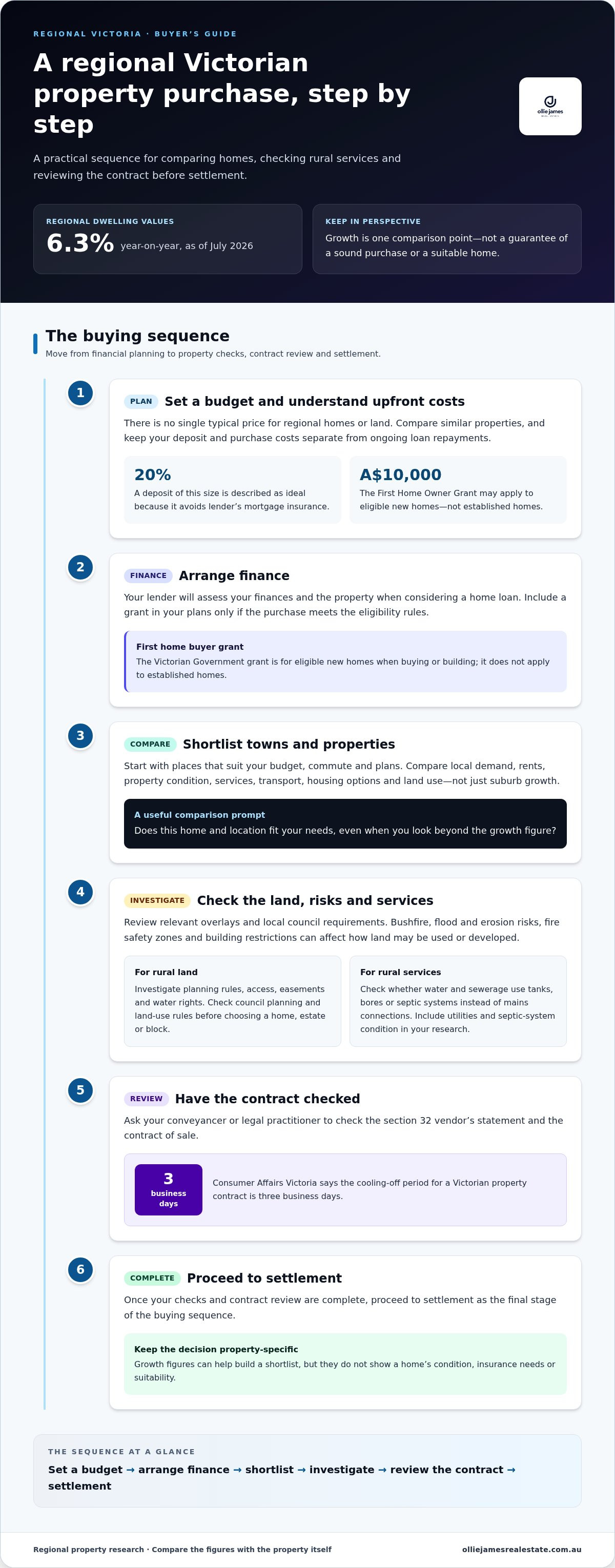
Regional Victorian dwelling values rose 6.3% year-on-year as of July 2026. Compare local demand, rents and property condition, not growth alone.
First home buyers may receive A$10,000 when buying or building a new home, according to the Victorian Government. The First Home Owner Grant is for eligible new homes, rather than established homes. The earlier A$20,000 regional grant applied to contracts entered into from 1 July 2017 to 30 June 2020. Before budgeting, separate your deposit and purchase costs from your ongoing loan repayments; a 20% deposit is described as ideal because it avoids lender’s mortgage insurance.
There is no single typical price for regional homes or land. Research comparable properties and check council planning and land-use rules before choosing a home, estate or block.
To buy, set a budget, arrange finance, shortlist properties, investigate the land, review the contract, then proceed to settlement. Your conveyancer or legal practitioner should check the section 32 vendor’s statement and contract of sale. Consumer Affairs Victoria says the cooling-off period for a Victorian property contract is three business days.
For bushfire, flood, erosion and planning risks, review relevant overlays and local council requirements, including fire safety zones and building restrictions. These can affect how land may be used or developed.
Rural homes may rely on septic systems, rainwater tanks or bores rather than mains services. Before buying, include water, sewerage, utilities and the condition of any septic system in your property research.
2. Where should you look for a home in Victoria?
Start with towns that suit your budget, commute and plans for the property. Sebastopol recorded a 217% year-on-year increase in buyer demand in August 2026. That signals stronger interest, not a guarantee that every home is a sound purchase. A buying property in regional Victoria guide is most useful when you compare local services, transport, housing options and land use, not just suburb rankings.
First home buyers may receive A$10,000 when buying or building a new home, according to the Victorian Government. The grant applies to eligible new homes, so an established property won’t meet that condition. Include it in your financial planning only if the purchase meets the eligibility rules. Your lender will also assess your finances and the property when considering a home loan.
Stamp duty concessions can affect the upfront cost. According to sro.vic.gov.au, Victorian first-home buyers who entered into a contract from 1 July 2017 could be exempt from stamp duty if the property’s dutiable value was A$600,000 or less. Eligible buyers purchasing a home valued between A$600,001 and A$750,000 could receive concessions on a sliding scale for contracts entered into from 1 July 2017. Use a buying property in regional Victoria guide to keep these thresholds in view while comparing locations and budgets.
For farmland or rural land, investigate planning rules, overlays, access, easements and water rights. Check whether water and sewerage rely on tanks, bores or septic systems rather than mains connections. These details can shape land use and ownership responsibilities. If you’re comparing homes in Central Victoria, explore regional residential property options alongside your shortlist.
3. Regional Victorian suburbs with the highest annual property-value growth
Nhill led the regional Victorian results, with annual property-value growth of 28.7% from mid-2025 to mid-2026. Its median property value was A$299,254. The figures below show how growth and median values varied across ten suburbs during the same period.
- Nhill: 28.7% growth; median value A$299,254.
- Dimboola: 21.2% growth; median value A$322,396.
- Morwell: 20.5% growth; median value A$436,671.
- Churchill: 20.0% growth; median value A$477,643.
- Rushworth: 19.9% growth; median value A$368,106.
- Rochester: 17.5% growth; median value A$458,035.
- Bagshot: 17.0% growth; median value A$664,656.
- Moe: 16.5% growth; median value A$448,881.
- Eildon: 16.4% growth; median value A$442,260.
- Sebastopol: 16.1% growth; median value A$515,286.
Nhill and Bagshot show why growth alone cannot determine which suburb is right for you. Nhill recorded the highest percentage increase, while Bagshot had the highest median value among these ten. Consider the starting value, property type and local conditions alongside the growth rate. A higher percentage does not reveal a home’s condition, insurance needs or suitability.
For an investment purchase, compare potential rental revenue with ownership costs and your borrowing position. Interest rates and property-specific expenses affect the financial picture. If you’re selling, recent local sales can help frame expectations, but suburb-wide figures do not value an individual home. Use the results to build a shortlist, then assess each property on its own merits.
Ollie James Real Estate: Residential Property Sales
Ollie James Real Estate supports home buyers and sellers through its Residential Property Sales service. Once you’ve shortlisted regional suburbs and are considering specific properties, the agency can guide you through the residential sales process. If you’re planning to sell, a free market appraisal can help inform your decisions about the move and your next purchase.
Buying and selling can feel demanding, especially when timing matters. Use suburb growth figures as context, then weigh each home’s condition, location and fit for your plans. If you’re selling land rather than a home, Ollie James Real Estate also provides Land Sales.
For a conversation about residential property sales, visit Ollie James Real Estate.
Take your next regional property step with confidence
A property search is easier to manage when you turn broad preferences into a clear shortlist: locations you’d consider, features you need and trade-offs you’re comfortable making. Keep that list alongside your finance and property checks as you move from research to viewings. This buying property in regional Victoria guide can help you get started, but your priorities should shape the decision.
If you’re buying or selling a home, Ollie James Real Estate’s Residential Property Sales service can support your property journey. Land Sales may suit a search focused on a block, while Property Management is relevant if your plans include a rental property. Choose support that fits your next step, not just the market headline.
For a conversation about your Bendigo and Greater Bendigo property plans, contact Ollie James Real Estate today. Take the next step at your own pace.
Frequently Asked Questions
Are house inspections important?
Yes. A house inspection can help identify defects that aren’t obvious during a viewing. Ask for clear findings on the roof, subfloor, moisture, drainage and visible plumbing, then consider them alongside the property’s age and maintenance history. For example, signs of damp in an older home may warrant closer investigation before you decide whether it suits your budget.
What do you need to know about the regional Victorian property market in 2026?
Sales volumes in regional Victoria increased 25.1% in the 12 months to June 2026. This indicates more transactions, but conditions still differ between towns and property types. The Department of Transport and Planning proposed 525,700 new dwellings across 48 regional Victorian Local Government Areas as part of a 30-year housing target. Consider local supply alongside current buyer activity.
What is impacting price growth in regional Victoria?
Price growth reflects the balance between buyer interest and the homes available for sale. A town’s employment options, services, transport links and housing mix can influence which buyers consider it. Property condition and land-use restrictions also shape a home’s appeal. Compare recent sales of similar properties rather than assuming one suburb’s growth rate applies across an entire region.
Where should you look for a home in Victoria?
For a Central Victoria search, compare Bendigo with Kangaroo Flat, Junortoun, Epsom, Eaglehawk, Strathfieldsaye, Strathdale, Kennington, Golden Square, California Gully, Maiden Gully and Marong. Build a shortlist around your daily travel needs, preferred home type and access to services. Then compare suitable properties in each area instead of choosing solely by suburb reputation.
Which regional Victorian areas offer the best value and amenities for buyers?
“Best value” depends on the balance you want between purchase cost, property condition and nearby amenities. Compare towns against your needs, including access to shops, health services, schools and transport. For each property, consider the full journey to the places you visit regularly. A lower-priced home may involve trade-offs in location, land features or upkeep.


