

The most costly mistake you can make when selling a deceased estate isn't a low sale price; it's a legal misstep with the Supreme Court that stalls your settlement for months. We understand that managing the selling a deceased estate in Victoria process while grieving feels like an exhausting balancing act. It is a high-pressure environment where the weight of legal obligations often clashes with the emotional need for closure. You likely feel the stress of managing conflicting opinions from beneficiaries while worrying about the strict requirements of Land Use Victoria and the Australian Taxation Office.
You deserve a transition that moves from legal uncertainty to a successful, fair settlement without the typical market anxiety. This guide provides the expert regional guidance you need to handle probate applications, understand the 2026 land tax exemptions, and prepare the property for the Central Victoria market. We will outline exactly when you can legally list the home. We also explain how to ensure a valuation that satisfies all parties and the specific steps required to protect the estate's interests. By the end of this article, you will have a clear, compassionate roadmap to move forward with confidence.
Key Takeaways
- Understand the vital legal requirements, including how to confirm a Grant of Probate through the Supreme Court before the property can be officially listed for sale.
- Learn to identify different ownership structures, such as Joint Tenants or Tenants in Common, to determine the correct path for a smooth title transfer.
- Navigate the selling a deceased estate in Victoria process with a clear timeline that balances strict legal obligations with the emotional needs of all beneficiaries.
- Discover how a professional, no-obligation appraisal provides a transparent and fair foundation for establishing market value and maintaining family harmony.
- Explore why specific sale methods, such as public auctions, can provide the transparency and local reach needed for a successful settlement in the Central Victoria market.
Navigating the Legal Essentials: Probate and the Victorian Land Registry
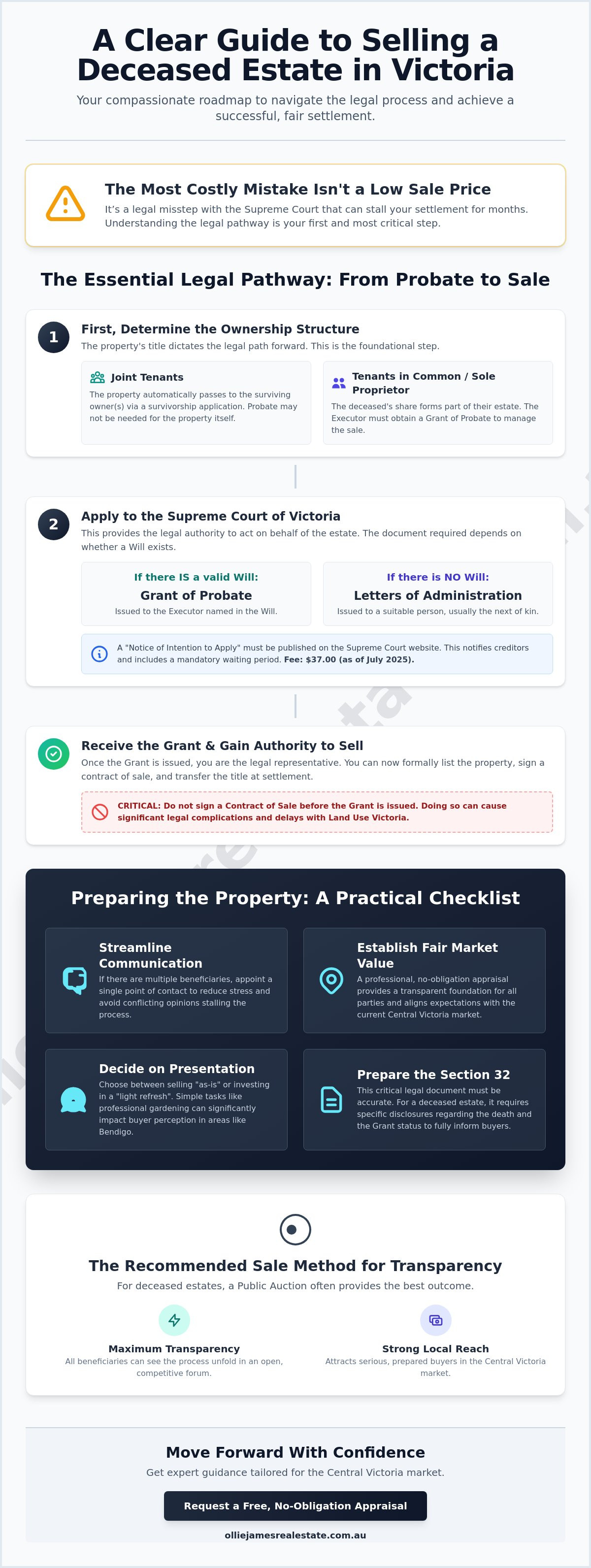
Before a property can reach the market, the legal groundwork must be laid. The first hurdle in the selling a deceased estate in Victoria process is obtaining the grant of probate or letters of administration. This official document from the Supreme Court of Victoria confirms that the executor has the legal authority to deal with the assets. While you can sometimes begin the marketing phase earlier, most legal practitioners advise against signing a contract of sale until the grant is in hand. This caution prevents potential complications with the Land Registry that could stall your settlement.
To get this grant, an executor must first publish a "Notice of Intention to Apply" on the Supreme Court website, which carries a $37.00 fee as of July 2025. This step is a necessary pause that ensures all creditors are notified. While this waiting period can feel frustrating, it provides the legal protection you need to proceed without the fear of personal liability.
Probate vs. Letters of Administration
If the deceased left a valid Will, the court issues a Grant of Probate to the named executor. In cases where there is no Will, the court issues Letters of Administration to a suitable person, usually the next of kin. In both scenarios, the chosen representative becomes the "legal owner" for the purpose of the sale. This status allows them to engage a specialist agency like Ollie James Real Estate to manage the transition from legal administration to a successful sale.
Understanding the title structure is also essential because it dictates your next steps. If the property was held as "Joint Tenants", it often passes to the survivor via a survivorship application. However, for a "Sole Proprietor" or "Tenants in Common", Land Use Victoria must formally transfer the title to the Executor. You cannot complete the final settlement with a buyer until the Supreme Court officially issues the Grant of Representation, as this is the only way to prove you have the right to sell and transfer the land.
The Section 32 Vendor Statement
A deceased estate Section 32 requires specific disclosures regarding the death and the status of the grant to ensure the buyer is fully informed. The Section 32 Vendor Statement is the critical legal document for any Victorian property sale. Getting this right early in the selling a deceased estate in Victoria process ensures that once you find a buyer, the path to settlement remains clear and stress-free.
Preparing a Deceased Estate for Sale: From Appraisal to Market-Ready
While the legal paperwork moves through the courts, the physical preparation of the home requires a different kind of care. This stage of the selling a deceased estate in Victoria process is often the most emotional for families. Deciding what to keep, what to donate, and how to present the property can feel overwhelming. We recommend taking a methodical approach to the removal of personal effects. Patience is key here; it is about honouring the home’s history while slowly transitioning it toward its future.
Managing the high-pressure real estate environment becomes much easier when you establish clear communication channels. If multiple beneficiaries are involved, having a single point of contact for the agent helps reduce the stress of conflicting opinions. This structure ensures that everyone feels heard without the process becoming stalled by indecision.
The Importance of a Local Appraisal
Establishing a fair market value early is essential for maintaining transparency among beneficiaries. Local Central Victoria market trends in 2026 show that buyers are increasingly looking for value in established suburbs. To provide clarity for everyone involved, you might consider requesting a free property value update. This ensures the estate is valued accurately based on current local demand rather than outdated expectations. While you manage the physical assets, you can refer to Victoria Legal Aid's guide to estate administration to stay aligned with your broader responsibilities as an executor.
Maintenance and Presentation in Central Victoria
The decision between selling "as-is" or investing in a "light refresh" depends heavily on the property's condition and the family’s capacity. In Bendigo and surrounding areas, simple tasks like professional gardening or a fresh coat of neutral paint can significantly impact the final result. For vacant homes, preparing for the winter frost is vital to prevent garden degradation or pipe issues. You can find specific staging tips and local maintenance advice in our 2026 Vendor’s Guide. If the property requires more attention than the family can provide, we can help you determine which improvements will actually add value. If you're unsure where to start, a Free, no obligation Appraisal of your property can help clarify the most effective path forward.
The Selling Process: Achieving a Respectful and Successful Outcome
Once the legal and physical preparations are complete, the focus shifts to finding the right buyer. In the selling a deceased estate in Victoria process, your real estate agent acts as much more than a salesperson; they are an objective mediator. When emotions are high, having a professional to handle negotiations ensures that all beneficiaries feel the outcome is fair and transparent. Our marketing strategies are specifically tailored to reach active buyers in local pockets like Epsom, Strathfieldsaye, and Kangaroo Flat, ensuring your property receives the attention it deserves from the Central Victoria community.
Auction vs. Private Treaty for Estates
Choosing how to sell is a significant decision that impacts both the timeline and family harmony. Auctions are often preferred for deceased estates because they offer complete transparency. Every bid is public, which protects the executor from potential claims of favouritism or undervalued sales. Conversely, a private treaty might suit a family seeking a quieter, less public transition with more control over the terms. At Ollie James Real Estate, we provide the steady, supportive guidance needed to choose the method that best aligns with your family’s unique situation and local market conditions.
Land Tax and Final Obligations
Before the final settlement occurs, you must address any lingering financial obligations to the state. The Victorian State Revenue Office has indicated increased scrutiny on Principal Place of Residence (PPR) exemptions for 2026. Generally, a deceased person's home remains exempt from land tax for a concessionary period until the earlier of the third anniversary of the death or the day the property is vested in a beneficiary. It is vital to track these dates carefully to avoid unexpected liabilities for the estate. For a broader look at these responsibilities, State Trustees' deceased estate services offer a comprehensive resource for Victorian executors managing these complex requirements.
The final settlement is the moment when the heavy lifting of administration concludes. Your estate solicitor will manage the distribution of proceeds according to the Will or the laws of intestacy. Moving from a state of grief-fuelled uncertainty to the empowerment of a completed settlement is a profound transition. It marks the end of a complex journey and provides the peace of mind that you have fulfilled your duties with integrity, honouring the legacy of your loved one while securing the future for the beneficiaries.
Move Forward with Clarity and Confidence
Successfully navigating the selling a deceased estate in Victoria process requires a delicate balance of legal patience and local market insight. By securing your Grant of Probate, preparing the home with care, and choosing a transparent method of sale, you ensure a fair outcome for all beneficiaries. This journey often feels like a high-pressure environment; however, having the right regional guidance can transform a stressful obligation into a peaceful transition. Our team brings over 17 years of local industry expertise in the Bendigo region to every sensitive sale we manage. As a family-owned agency, we prioritise honest, personalised support, acting as a stabilising force for your family during this time.
If you are ready to take the next step, we are here to help you navigate the complexities with integrity and empathy. Book a respectful, no-obligation appraisal for your family estate today to gain a clear, professional understanding of your property's current value. You don't have to manage this transition alone; expert support is just a conversation away.
Frequently Asked Questions
Can I list a deceased estate for sale before Probate is granted in Victoria?
You can legally list a property and even sign a contract of sale before probate is granted, provided the contract includes a specific condition making the sale subject to the Supreme Court issuing the Grant of Probate. While this allows you to start the marketing phase early, most legal experts recommend waiting until the grant is confirmed to avoid settlement delays. This approach ensures you don't find yourself in a situation where a buyer is ready to move in but the legal title hasn't yet been transferred.
Who is responsible for property maintenance while the estate is being settled?
The executor or administrator holds the primary responsibility for maintaining the property until the settlement is finalised. They must ensure the home remains insured, secure, and in reasonable condition to protect the value of the asset for all beneficiaries. Usually, the costs for gardening, cleaning, or minor repairs are reimbursed from the estate's funds. It's a vital part of the selling a deceased estate in Victoria process to keep the property market-ready during the administration period.
Do all beneficiaries need to agree on the sale price of the house?
Legally, the executor has the final authority to make decisions regarding the sale price and the method of disposal. However, they have a fiduciary duty to act in the best interests of all beneficiaries and must aim to achieve a fair market value. Obtaining a professional appraisal helps provide the transparency needed to prevent family disputes. While unanimous agreement isn't a strict legal requirement, maintaining open communication ensures a smoother transition and reduces the risk of legal challenges against the estate.
Are there specific tax implications when selling a deceased estate in Victoria?
Several tax considerations apply, most notably Capital Gains Tax (CGT) and Land Tax. An inherited property is generally exempt from CGT if it was the deceased’s main residence and is sold within two years of their death. Additionally, the Victorian State Revenue Office provides a land tax concession for deceased estates that typically lasts for up to three years. Because the ATO is applying stricter interpretations in 2026, it is essential to consult with your solicitor to confirm how these rules apply to your specific situation.


