
What if the difference between a record-breaking sale and a costly legal hurdle isn't the sign on the fence, but the specific details buried in your Section 32? It's entirely natural to feel a weight of responsibility when learning how to sell a block of land in Victoria, especially with the 2026 statewide expansion of the Vacant Residential Land Tax and shifting regional values. You might worry that a simple oversight in zoning or a misunderstanding of the current market could stand between you and the right buyer.
We understand that selling land is about more than just a transaction; it's about finding peace of mind through expert guidance. This guide provides a clear path to mastering the legal requirements and marketing strategies needed to attract a premium price. Whether you're dealing with developers or lifestyle seekers, our goal is to turn your uncertainty into a smooth, successful result.
We'll walk you through the essential steps of preparing your Vendor Statement, identifying your property's true value in the current economy, and reaching the buyers who truly appreciate your land's potential.
Key Takeaways
- Understand the non-negotiable requirements of the Section 32 Vendor’s Statement to ensure your sale remains legally compliant and transparent from the outset.
- Learn why commissioning a professional land survey is a vital step in preventing boundary disputes and providing absolute certainty to potential buyers.
- Discover how to sell a block of land in Victoria by tailoring your marketing to specific buyer profiles, such as regional developers or lifestyle seekers.
- Maximise your allotment's value with simple presentation strategies, including clearing overgrown weeds and fixing boundary fences to improve immediate kerb appeal.
- Gain the confidence to choose the most effective sales method for your specific region, whether that involves a flexible private treaty or a competitive auction.
Preparing Your Allotment: The Legal and Technical Essentials in Victoria
Selling land involves more than just finding a buyer; it's about ensuring your legal foundation is rock solid. In Victoria, property transactions operate under the Australian Property Law Framework, specifically the Torrens title system. This means the title is everything. If you're wondering how to sell a block of land in Victoria without hitting roadblocks, start by verifying your boundaries and service connections. A current land survey is vital because it prevents boundary disputes during settlement that could otherwise derail your plans.
To better understand the steps involved in a Victorian property transaction, watch this helpful video:
The Critical Role of the Section 32 Vendor Statement
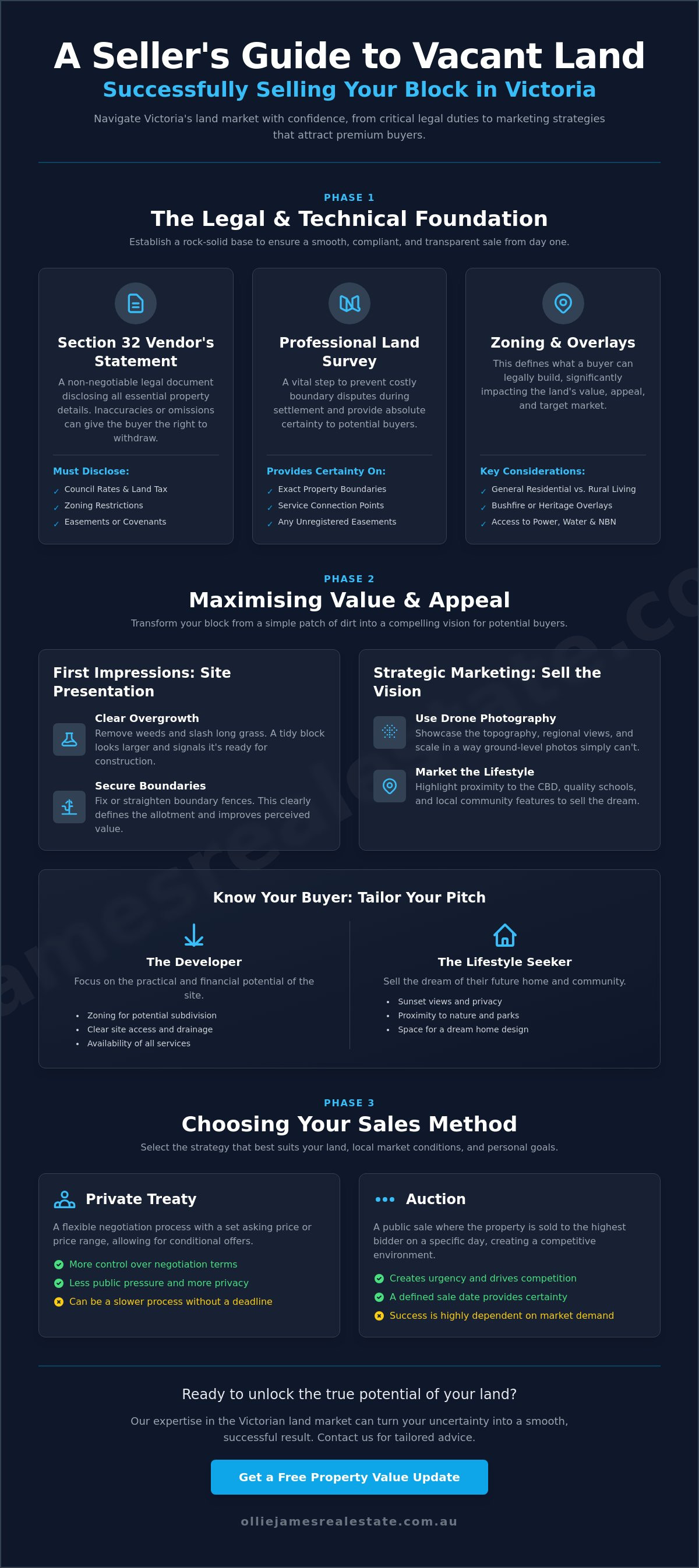
The Section 32 is a non-negotiable legal document required by the Sale of Land Act 1962. It must disclose council rates, land tax, zoning restrictions, and any easements or covenants. If this statement is incomplete or contains errors, a buyer has the legal right to withdraw from the contract before settlement. We recommend engaging a Victorian conveyancer or solicitor early to prepare this. Having a robust Section 32 ready when you list your property builds immediate trust. It ensures you stay in control of the process and provides the transparency buyers need to commit.
Zoning and Overlays: What Can Your Buyer Actually Build?
Potential buyers need to know the possibilities for the land. Is it zoned as General Residential, Township, or Rural Living? Each has different building requirements. Overlays add another layer of complexity. For instance, a Bushfire Management Overlay (BMO) or a Heritage Overlay can significantly impact building envelopes and the clearing of native vegetation. Providing a planning certificate can offer the certainty buyers crave. It's also wise to confirm if services like water, power, and NBN are already at the boundary. If you're ready for a free property value update, knowing these details about how to sell a block of land in Victoria will help you set a realistic and premium price.
Maximising Value: Positioning Your Block for the Central Victoria Market
Positioning a block of land isn't just about the soil; it's about selling a vision. If you want to know how to sell a block of land in Victoria for a premium price, you have to speak the language of your specific buyer. A developer looks for drainage and site access, while a tree-changer looks for the perfect sunset view. Identifying these motivations early allows you to tailor your marketing and presentation to the people most likely to see the true worth of your allotment.
Vacant land often gets neglected, but "kerb appeal" is just as vital here as it is for a house. Clearing overgrown weeds and ensuring boundary fences are straight and secure makes a massive difference. It signals to prospective buyers that the land is well-maintained and ready for construction. While the Victorian Government Guide to Selling Property provides the procedural framework, your personal leverage lies in how you present the site's potential. Using professional drone photography is another essential tool. It showcases the topography and regional views that a ground-level photo simply can't capture, giving buyers a sense of the land's scale and surroundings.
Marketing the Lifestyle, Not Just the Soil
Don't just list the dimensions. Talk about the proximity to the Bendigo CBD or the quality of local schools in growing hubs like Strathfieldsaye and Maiden Gully. Lifestyle allotments are highly sought after in Central Victoria, and your listing should reflect the community roots of the area. For those looking for more specific regional advice, our resource on Sell My Land Greater Bendigo offers deeper insights into local market trends.
Strategic Presentation and Signage
A high-quality physical sign on the block remains one of the best ways to capture interest from locals who already love the neighbourhood. We also find that virtual renders are incredibly effective. They help buyers visualise a beautiful home on what is currently an empty site. This level of professional presentation reduces buyer anxiety by removing the guesswork. If you're curious about your land's current worth, requesting a free property value update is a great way to start your journey with confidence.
Navigating the Sale: From Listing to Settlement with Confidence
The final stage of your journey is often the most intense. Once the marketing has done its job, you move into the delicate phase of vetting enquiries and managing offers. Choosing the right sales method is a pivotal decision. While auctions can create a sense of urgency in high-demand areas, a private treaty sale often provides the flexibility needed for complex land deals. Understanding how to sell a block of land in Victoria requires a steady hand during these negotiations. We focus on ensuring that every offer is backed by financial readiness, which prevents the heartbreak of a deal falling through at the last minute.
Negotiation is an art. It's about more than just the price; it's about the terms that provide you with security. During this time, we often discuss the Section 27 procedure, which may allow for the early release of the deposit before settlement. While the buyer is typically responsible for Land Transfer Duty in Victoria, understanding these external costs helps you gauge a buyer's true capacity. Our role is to act as a stabilizing force, moving you from the pressure of the market to the clarity of a signed contract.
The Sales Process: A Step-by-Step Timeline
A successful sale follows a logical, methodical progression. We begin with a thorough appraisal and legal preparation to ensure your Section 32 is ready. This is followed by the marketing launch and active negotiation with interested parties. Once you are under contract, we manage the Victorian cooling-off period and any conditions. Finally, settlement day arrives, and the title is officially transferred. If you're ready to start this process, you can reach out to Ollie James Real Estate for a free, no-obligation land appraisal.
Why Local Expertise Outperforms Private Sales
Attempting a private sale might seem like a way to save on costs, but it often ignores the immense value of a local agent's database. We maintain deep connections with local builders and developers who are constantly looking for their next project. This network provides a pool of vetted buyers that a simple online listing cannot reach. Furthermore, we manage the risks associated with the three-day cooling-off period and handle the high-pressure conversations that define real estate. This expert support ensures you don't leave money on the table and provides the peace of mind that only comes from dedicated, regional insight.
Your Path to a Successful Land Sale in Central Victoria
The journey from listing to settlement doesn't have to be a source of anxiety. By focusing on a precise Section 32, presenting your land with clear intent, and leveraging regional insights, you move from a place of uncertainty to one of total confidence. Understanding how to sell a block of land in Victoria is ultimately about balancing these legal essentials with a narrative that speaks directly to the right buyer's aspirations.
At Ollie James Real Estate, we've spent over 17 years refining our expertise right here in Central Victoria. As an independent, family-owned agency, we specialise in the unique nuances of regional land and lifestyle allotments. We pride ourselves on providing the personal attention and specialised knowledge that larger organizations often overlook. Our role is to act as your stabilising force, offering the clarity and support needed to navigate a volatile market with ease.
If you're ready to take the next step toward a premium result, we're here to guide you. Book your free, no-obligation land appraisal with Ollie James today and discover the difference that genuine local insight makes. You've done the hard work of holding the land; now let us help you realise its full potential.
Frequently Asked Questions
Do I need a solicitor to sell land in Victoria?
You definitely need a legal professional, such as a solicitor or a licensed conveyancer, to handle the transfer of land in Victoria. They are responsible for preparing the Section 32 Vendor Statement and the Contract of Sale. This ensures all legal disclosures are accurate. Having professional oversight provides you with the security that your interests are protected throughout the entire settlement process.
How much does it cost to sell a block of land in Victoria?
Selling land involves several standard costs including real estate commissions, marketing fees, and legal expenses. In regional Victoria, conveyancing fees usually fall between $700 and $2,200. You might also encounter mortgage discharge fees or specific government charges like the Transfer of Land Act fees. Understanding these outgoings early helps you calculate your net return when learning how to sell a block of land in Victoria.
How long is the cooling-off period for land sales in VIC?
The standard cooling-off period for property sales in Victoria is three business days from the date the buyer signs the contract. This period allows a buyer to withdraw from the sale, though they'll usually forfeit a small percentage of the purchase price. It's important to remember that this cooling-off period doesn't apply if the land is sold at auction or within three business days before or after a scheduled auction.
Can I sell my land if there is still a mortgage on it?
You can certainly sell your land even if there is an existing mortgage registered on the title. Your solicitor or conveyancer will coordinate with your bank to arrange a discharge of mortgage in time for settlement. The outstanding loan balance is simply paid out directly from the sale proceeds on the day the property settles. This is a routine part of the transaction that your legal representative will manage for you.
What is the difference between a private sale and an auction for land?
A private sale involves listing the land at a set price and negotiating with individual buyers, while an auction is a public event where buyers compete through bidding. Private sales offer more flexibility and a cooling-off period for the buyer. Auctions create a sense of urgency and result in an unconditional contract once the hammer falls. Both methods are effective depending on the current demand in your specific region.
Do I need to pay Capital Gains Tax (CGT) when I sell my land?
Capital Gains Tax generally applies if the land you are selling is an investment or has increased in value since you purchased it. If you've held the allotment for longer than 12 months, you might currently be eligible for a 50% CGT discount. However, tax laws are changing from 1 July 2027, so it's vital to consult with a qualified accountant. They can provide clarity on your specific tax obligations when figuring out how to sell a block of land in Victoria for the best financial outcome.


